Whiskers, Moles, Eyes, Ear, Lips
Extract from the monograph The Mystery of the Lost Daguerreotype — Tracing Lincoln’s Image in 1861 (Senigallia, MMXXVI).
Anthropometric Measurements
«The bones of the face are the most important structures used in identifying people, and in the case of this book, their faces in photographs. The face is a reflection of those underlying bones of the skull that determine such things as the heights of our forehead and chin, the length of our nose, the distance between our eyes, the width of our cheeks, etc.» (John Sotos, The Physical Lincoln Sourcebook, 2008)
The subject daguerreotype portrait is seen from a low angle, approximately 8°. Among all known Abraham Lincoln portraits, there are no comparable examples. This angle is atypical for studio practice and suggests an outdoor improvisation.
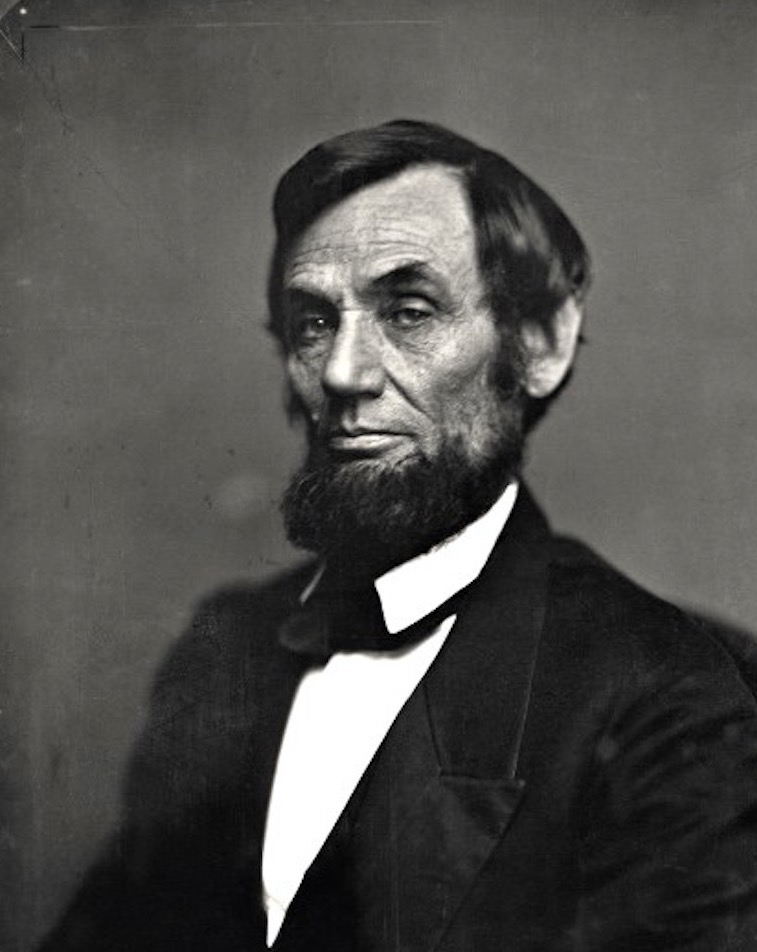
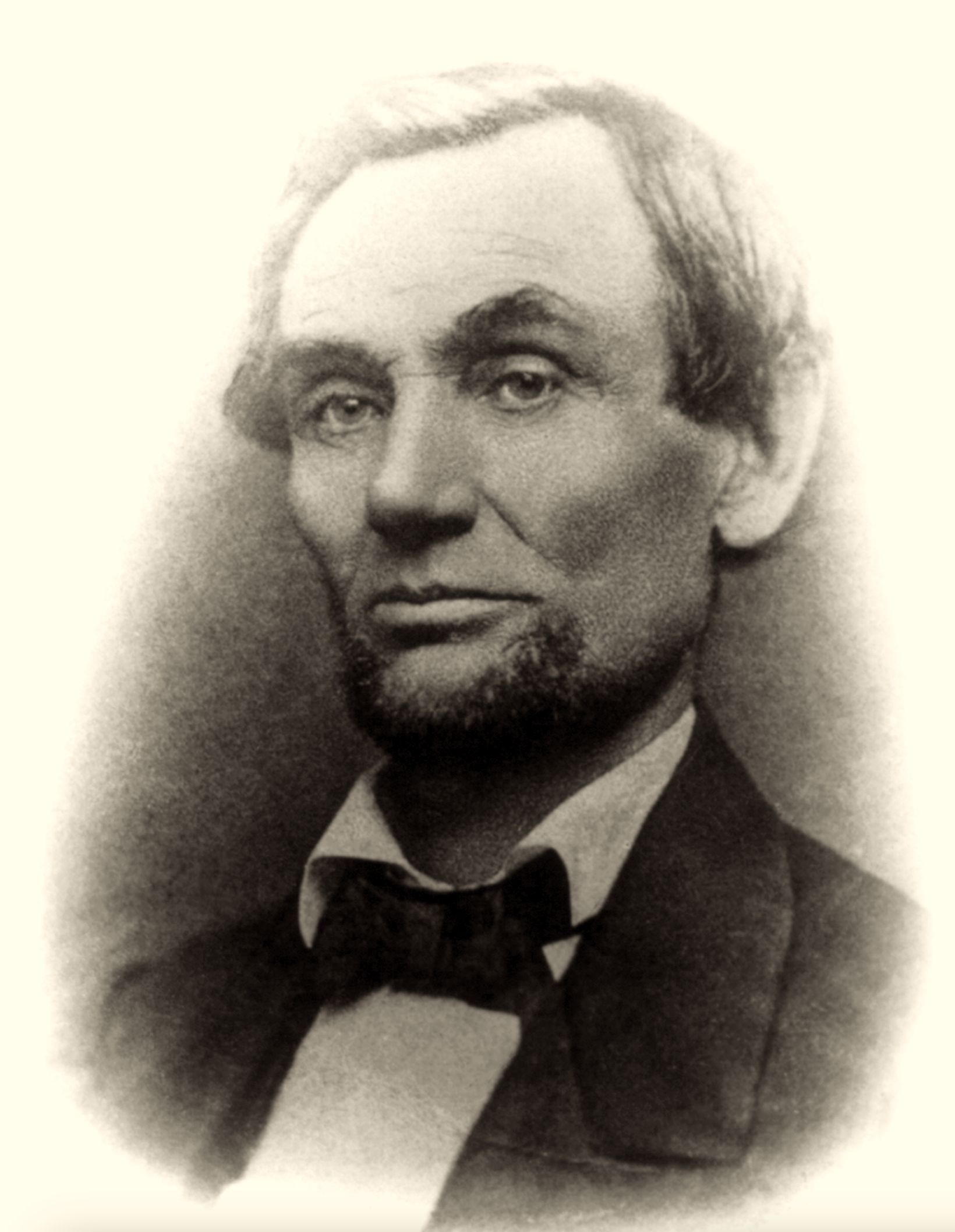
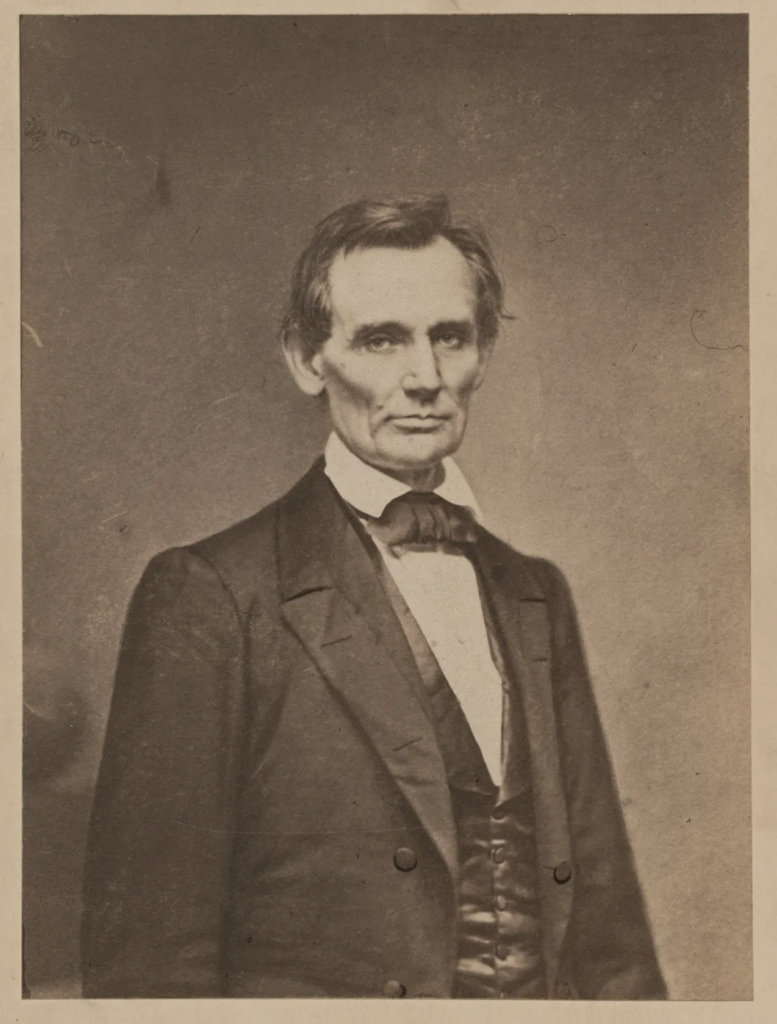
We selected validated Abraham Lincoln portraits with a somewhat similar facial approach, specifically O-40 and O-118. The portrait was analyzed using the latest artificial intelligence face recognition software to recalculate matching anthropometric measurements. The analysis returned positive matching results from our tests.
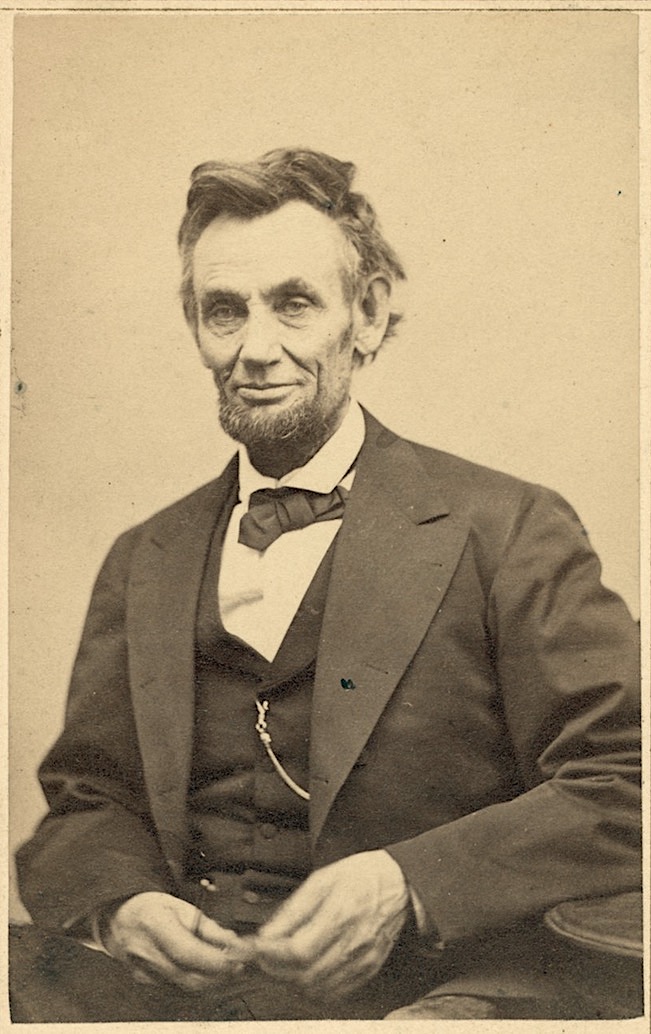
To ensure transparency and encourage independent verification of our findings, we invite researchers and interested parties to replicate our analysis using publicly available facial recognition applications. This approach aligns with the scientific method’s principles of reproducibility and peer review. Methodology for replication: utilize a high-resolution digital copy of the subject daguerreotype; select reputable facial recognition software or online platforms; compare with verified portraits of Abraham Lincoln, particularly O-40 and O-118; report the results, noting any discrepancies or confirmations with our findings.
In 1860, the British journalist Edward Dicey reported:
«A head, coconut shaped and somewhat too small for such a stature, covered with a rough, uncombed and uncombable lank dark hair, that stands out in every direction at once; a face furrowed, wrinkled, and indented, as though it had been scarred by vitriol… and, sunk beneath bushy eyebrows, two bright, somewhat dreamy eyes, that seemed to gaze through you without looking at you; a few irregular blotches of black bristly hair in the place where beard and whiskers ought to grow; a close-set, thin-lipped, stern mouth, with two rows of white teeth; and a nose and ears, which have been taken by mistake from a head of twice the size.»
Untrimmed Whiskers
The character we’re trying to identify is growing an untrimmed beard. The President-Elect let his whiskers grow for three months, until his arrival in NYC on the evening of Tuesday, 19 February 1861. Three known portraits of the President-Elect growing his beard: O-40, O-43, O-45, with their variants.
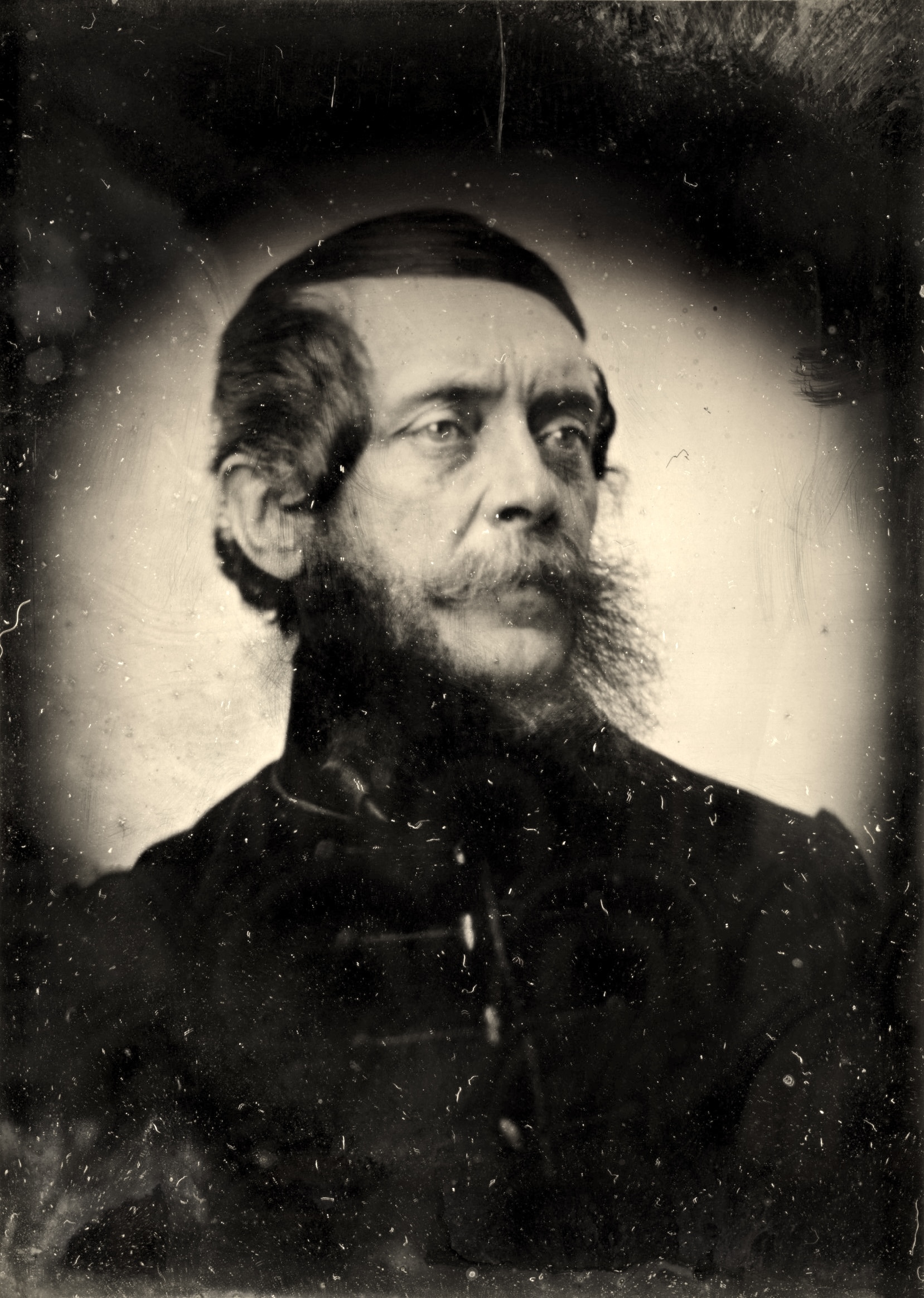
Before the 1850s, beards were not popular among respectable middle-class men in America. The visit of Hungarian patriot in exile Lajos Kossuth in 1851-1852 influenced the perception of beards. Lincoln dedicated a public event to Kossuth’s visit in the United States.
The story of 11-year-old Grace Bedell is well known. Just before November 1860, she wrote to Lincoln suggesting he grow a beard. Lincoln answered and later met Grace Bedell in February 1861 during his train journey to Washington. He acknowledged her influence on his decision but noted he was « acting partly upon her suggestion. »
As Louise L. Stevenson notes in Lincoln in the Atlantic World:
«Given the impact of Kossuth on Lincoln’s rhetoric, choice of clothing, and references to Russia, Kossuth probably played a role in Lincoln’s qualification of Grace’s influence. In the transatlantic world, facial hair on the chin had suggested eccentricity and won little acceptance in respectable circles… Eight years after the Kossuth visit… Lincoln not only would look more handsome, he also would look more republican — to an audience of liberals in the United States and beyond…»
As Harold Holzer notes in Lincoln President-Elect:
«Lincoln apparently decided he was not attractive enough. And for once in his life, he did something about it. For the first time, he began cultivating a beard.»
One day of mid-November 1860, as his barber William Florville (William de Fleurville, 1807-1868) prepared to give him his customary shave, Lincoln stopped him. «Billy,» he reportedly said, «let’s give them a chance to grow!» The result transformed Lincoln.
«Old Abe looks as though the campaign had worn lightly upon him. He is commencing to raise a beautiful pair of whiskers, and looks younger than usual. Still there is no disguising the fact that he is homely.» (Lexington Globe, 22 November 1860)
Moles and Scars
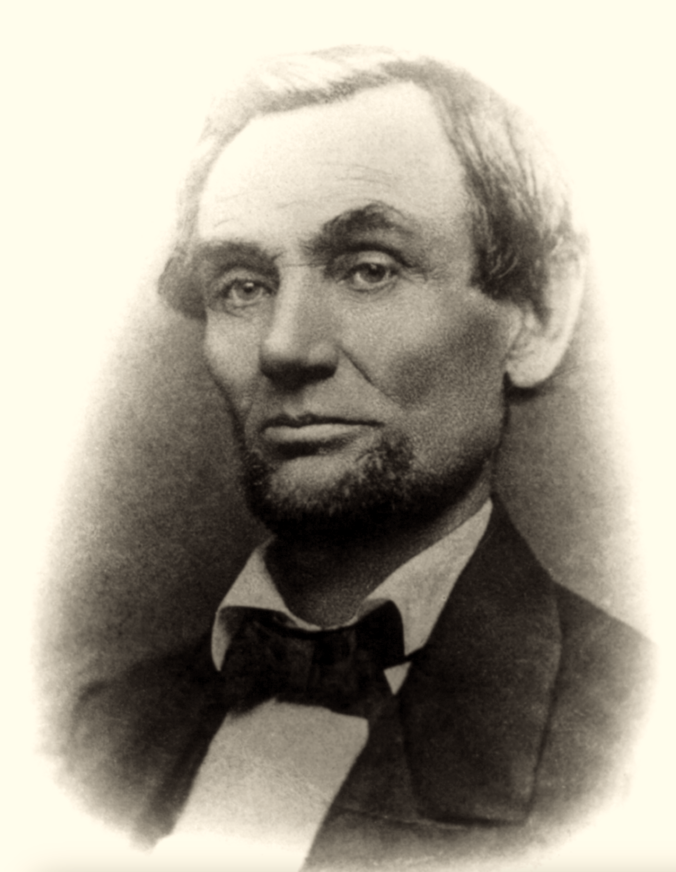
Abraham Lincoln’s known facial features include an often-visible mole on the right cheek, a visible scar under his left lip, and another scar under his right eye — the latter two acquired in early childhood.
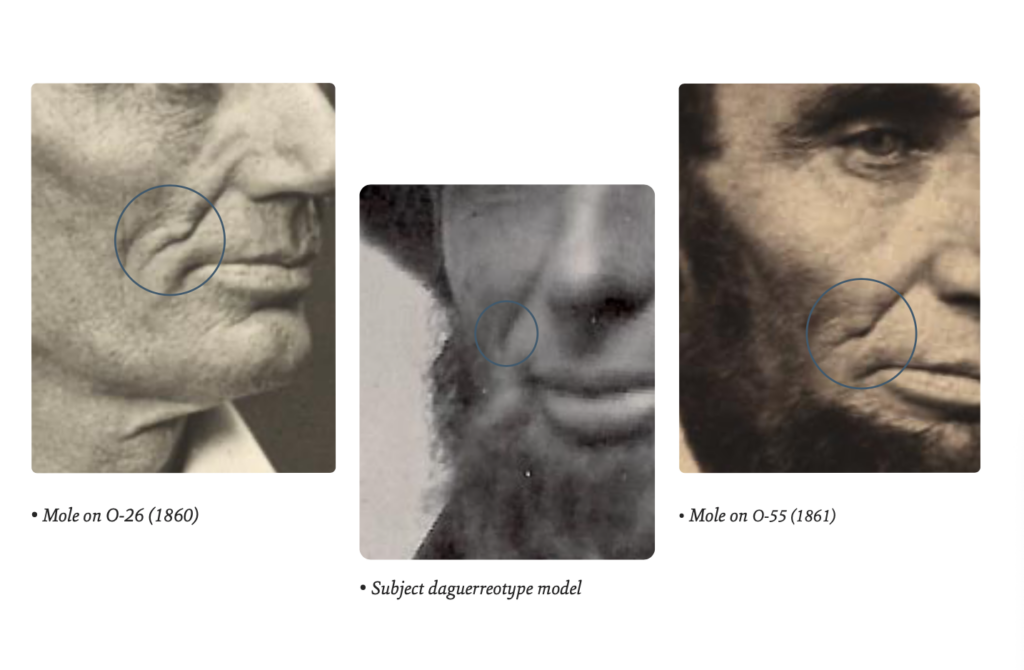
We enlarged and lightened the area of the character’s cheek, revealing a darker area that could correspond to a mole on the crease. We compared this with Abraham Lincoln portraits O-26 and O-55.
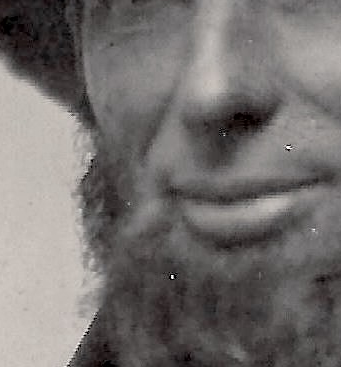
We enlarged the relevant areas and compared both of them with Abraham Lincoln portrait O-5.
At age ten, Lincoln sustained a major head trauma from a horse kick, resulting in loss of consciousness. The incident occurred at Gordon’s gristmill near Little Pigeon Creek, Indiana, in 1818:
«When he arrived one day in 1818 there were others waiting in front of him. Watching the horses slowly go round and round, young Lincoln commented that « his dog could eat the meal as fast as the mill could grind it. » Eventually it was Abraham’s turn, and he hitched his old mare to the gristmill’s arm. To keep the horse moving, he hit it with a whiplash, clucked in the normal manner, and shouted, « Git up, you old hussy; git up, you old hussy. » Just as he yelled the words « Git up » again, the horse kicked backwards with a hind foot hitting the boy in the head. Lincoln was knocked down and out… He lay unconscious all night… The next morning one onlooker cried, « He’s coming straight back from the dead! » Abraham jerked all over. Suddenly he blurted out the words « You old hussy, » thus finishing what he was about to say before the horse knocked him out. In discussing the affair, Lincoln himself used the words « apparantly killed for a time. »» (Louis A. Warren, Lincoln’s Youth, 1959)
As a result of this injury, Lincoln suffered from diplopia (double vision) and outward deviation of the left eye due to partial paralysis of small eye muscles.
Eye Features
In 1859, Abraham Lincoln provided a brief autobiographical sketch, including a self-description:
«If any personal description of me is thought desirable, it may be said, I am, in height, six feet, four inches, nearly; lean in flesh, weighing, on an average, one hundred and eighty pounds; dark complexion, with course black hair, and grey eyes — no other marks or brands recollected.»
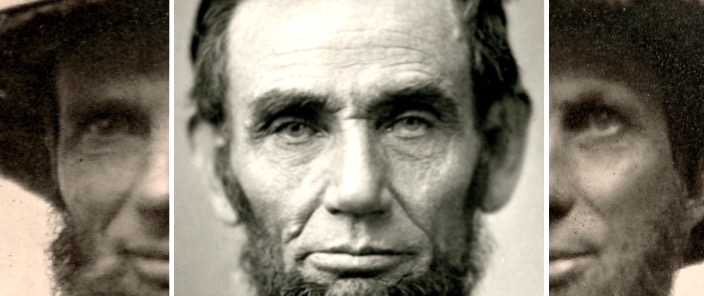
Subject daguerreotype analysis: color — green, blue or grey; eye orbit height measured from the highest point of the eyelid fold to the lowest point of the inside edge of the lower eyelid; inner and outer eye corners measured; the right eye does not open as much as the left, the white part under the pupil is hardly visible; eyelid drooping noted, making the width of the eye more prominent.
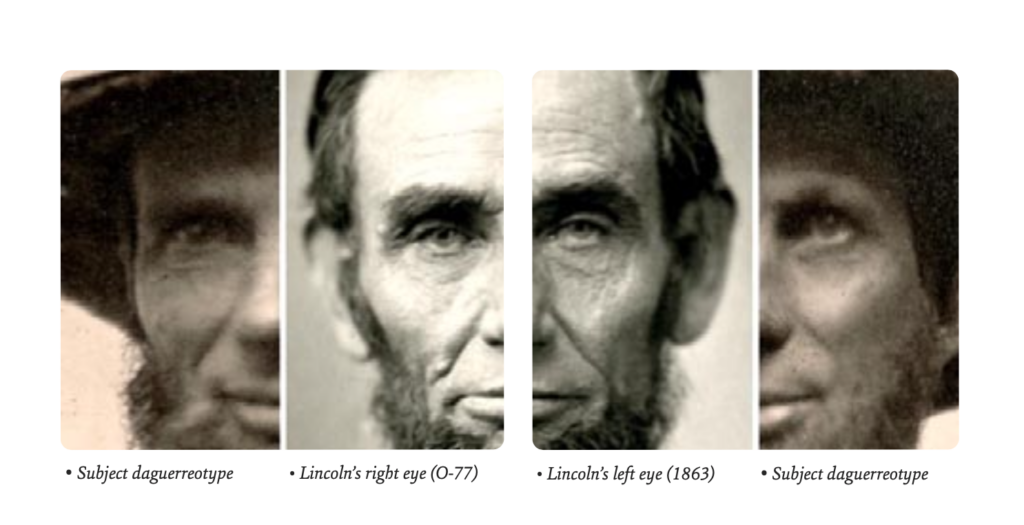
Abraham Lincoln’s known eye features: color grey, as described by Lincoln himself in an 1859 autobiographical sketch; «the sporadic drifting of his right eye, noted by Lincoln’s contemporaries, was most likely caused by strabismus, a possible result of facial microsomia.» (John G. Sotos, The Physical Lincoln, 2008)
We compare the shape and sizes of the subject’s eyes with Abraham Lincoln portraits O-4, O-5, and O-77.
Left Ear Shape
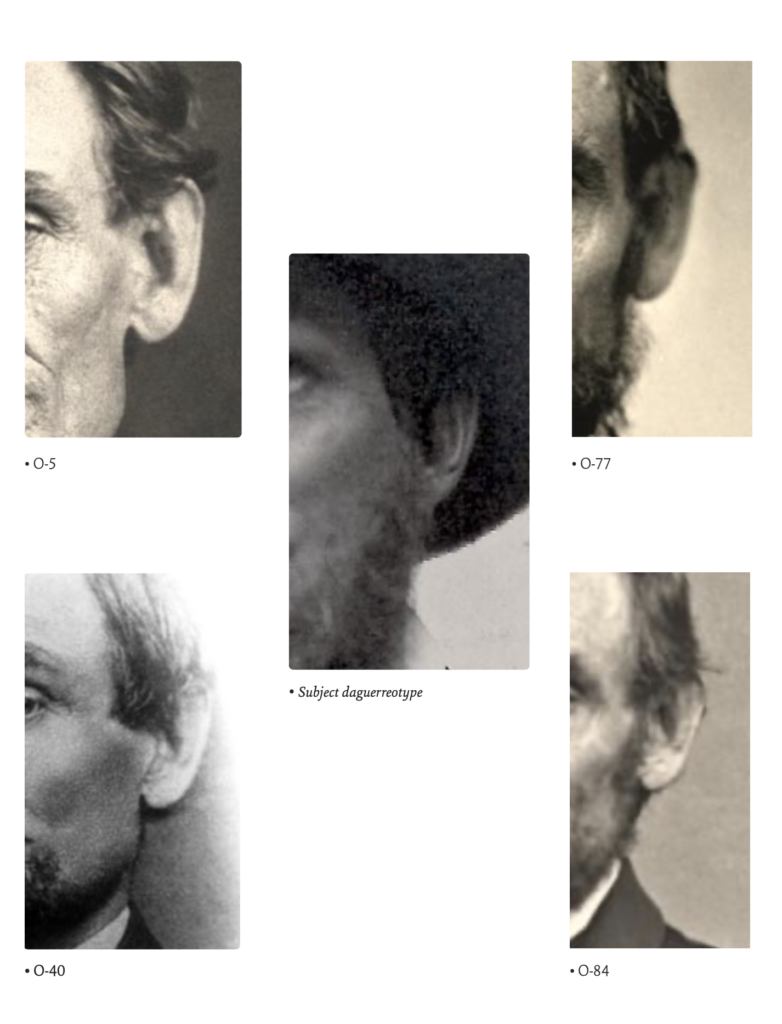
Ears are a crucial feature in the identification process, as they are unique to each individual and remain relatively unchanged throughout adulthood. In forensic science and biometric identification, ear shape and structure are considered highly reliable markers. In the subject daguerreotype, we can see only the left ear, which provides an important point of comparison with known images of Abraham Lincoln.
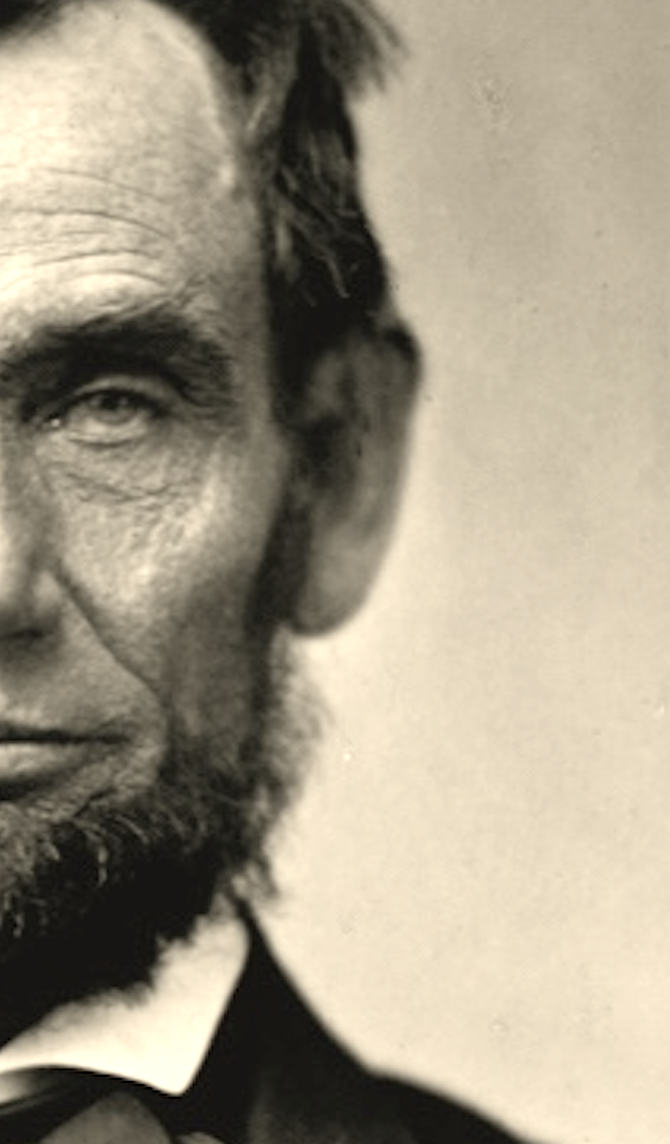
The candidate’s left ear is visible, but the earlobe is hardly seen behind the sideburns. Due to this partial visibility, one cannot determine if the earlobe is free or attached.
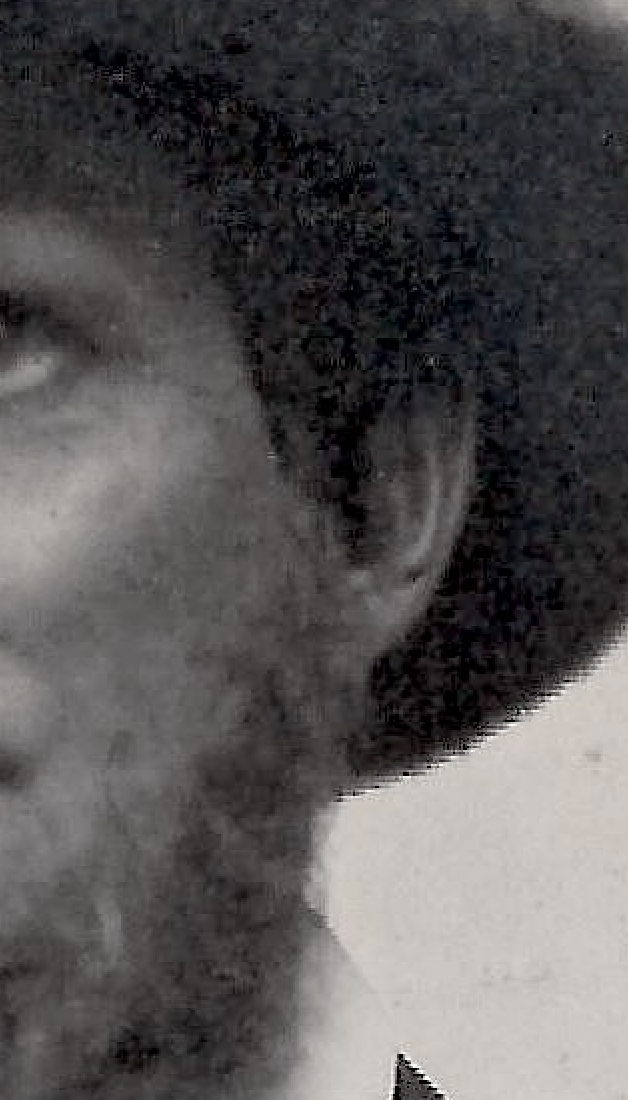
In 1860, British journalist Edward Dicey reported that Lincoln had «a nose and ears, which have been taken by mistake from a head of twice the size.»
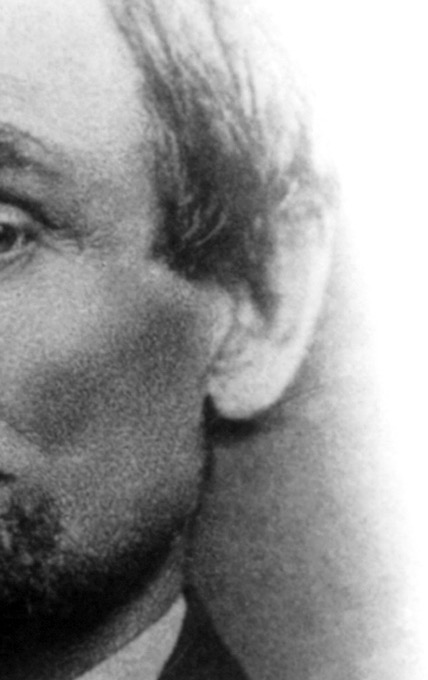
We compare the subject’s left ear with Lincoln portraits O-5, O-40, O-77 and O-85. We find the left ear very similar to these known Lincoln images. We note a remarkably similar lateral corner of the eyebrow and its positioning relative to the ear in comparison to known Lincoln images.
Mouth and Lips Design
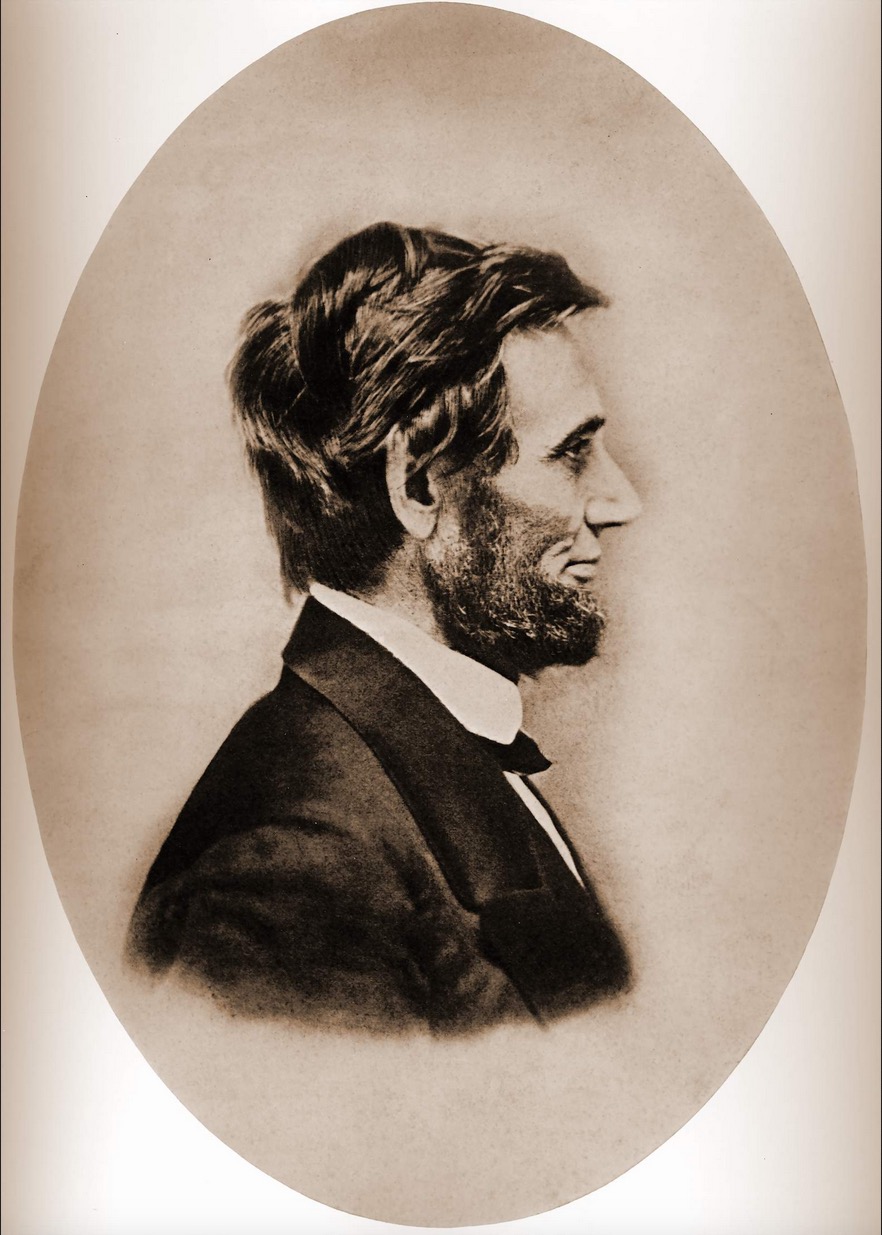
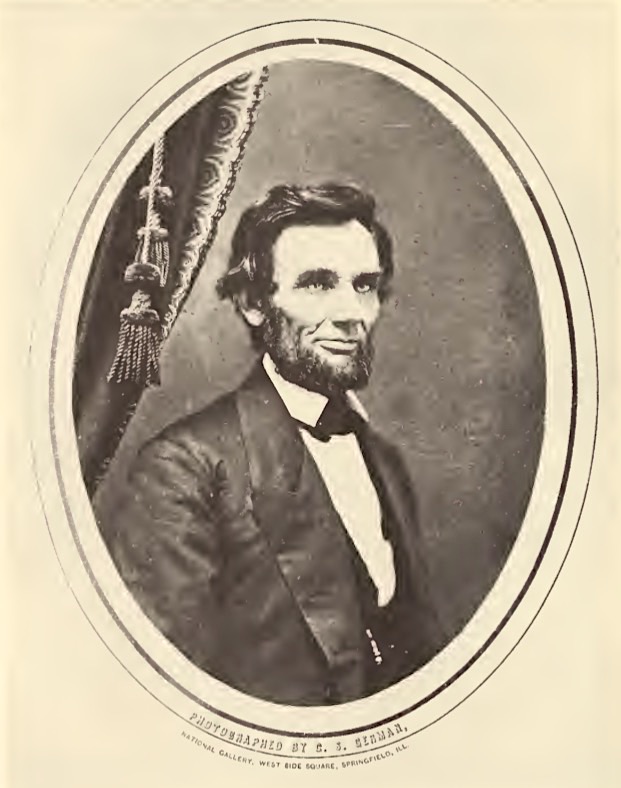
To analyze the subject’s mouth and lip characteristics, we conduct a detailed comparison with four well-documented photographic portraits of Abraham Lincoln from 1860, 1861, and 1865 (O-18, O-26, O-55, O-118), where the lips are clearly visible and precisely detailed.
Abraham Lincoln’s lips features (as described by John Sotos in Physical Lincoln, « Lips in three dimensions »): lip lumps (masses) are visible in the lips and in the skin near the lips. Top: two masses are subtly visible, both in front view and in side view. Bottom: two large masses occupy Lincoln’s right lower lip almost completely, and there is a suggestion of a mass on the lower left lip, just off the midline. Philtrum: the distance between the upper lip and the nose. Stomion: the lip fissure midpoint round space under the philtrum, in the middle of the fissure.
We choose Abraham Lincoln portraits O-18, O-26, O-55, O-118 to compare with the subject daguerreotype. The lips zone is slightly blurry; we propose compatibility rather than exact matching. We observe similarities with lumps, philtrum, stomion but invite readers to make their own observations.
Discreet Hint of a Smile
We guess the hint of a smile. While modern audiences might perceive Abraham Lincoln as rarely smiling in portraits, contemporary accounts paint a different picture:
«His large bony face when in repose was unspeakably sad and as unreadable as that of a sphinx, his eyes were as expressionless as those of a dead fish; but when he smiled or laughed at one of his own stories or that of another then everything about him changed; his figure became alert, a lightning change came over his countenance, his eyes scintillated and I thought he had the most expressive features I had ever seen on the face of a man.» (Dr. James Miner)
Lincoln’s private secretary John Nicolay observed: «The question of looks depended in Lincoln’s case very much upon his moods… The large framework of his features was greatly modified by the emotions which controlled them.»
George Peter Alexander Healy’s 1860 portrait, the last to show Lincoln without a beard, captured a unique moment. As Duncan Phillips noted:
«This is a happy Lincoln with a glint of the famous humor which was to mitigate his sorrows and his cares… It is a disarmingly personal impression of the eyes of true greatness at a moment when they were lighted with the surprise, the honor, and the vision of supreme opportunity.»
A comprehensive description of Lincoln’s face reveals its complexity:
«He spoke of himself as homely, but in many ways he was handsome. There was an uncommon virility in his looks. Early photographs show a face toughened by frontier life, hard as a hickory knot. Its sheer, rugged power is appealing; but taken one by one, the features are unattractive. Yet this face is an anomaly. Under the heavy eyelids is an alert glint with just a touch of humor. His eyes are at the same time cold and warm, penetrating and dreamy. The pursed thick lips, clenched with determination, seem always on the verge of a smile. During the war years, successive photographs reveal not just the aging of his face but the growth of a spiritual power which supplants ambition. Toward the end, his features, weary and ready for sleep, show a sort of peace even when the sadness lies in dark pools under his eyes… It is a wonderful face — a good face to look at and to study, for it has just enough mystery so that you can almost, but not quite, touch the man behind it!»
A local journalist’s account during Lincoln’s journey as president-elect provides further insight:
«A local journalist detected in the president-elect’s eyes « a blending of gravity and goodness » which « wins confidence and affection, and satisfies one of his fitness for the great office. » His smile conveyed « much evident sincerity » and his bow « real courtesy. »» (Erie Weekly Gazette, 21 February 1861)
A few days later, Joseph Howard Jr. added:
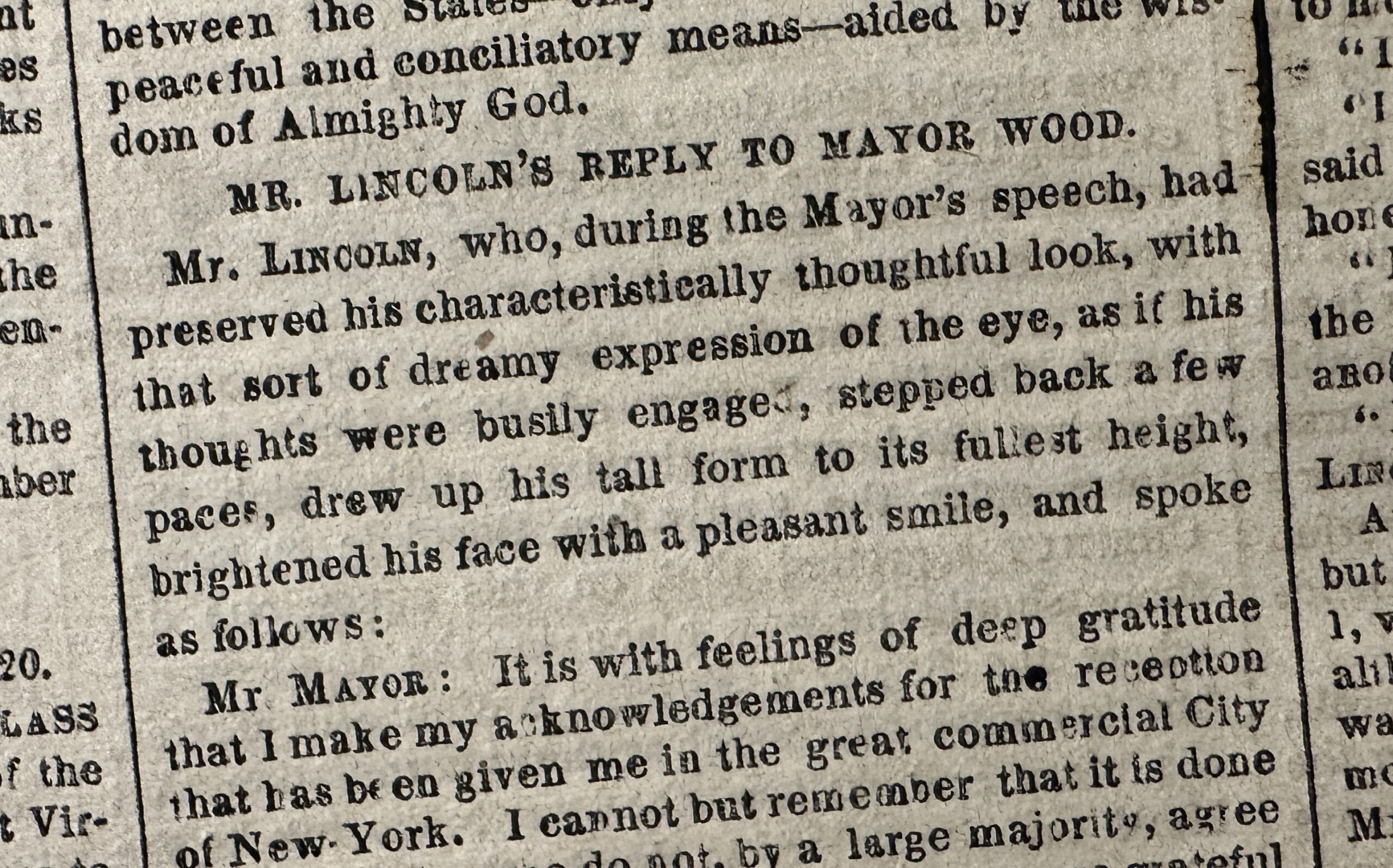
«Mr. Lincoln, who, during the Mayor’s speech, had preserved his characteristically thoughtful look, with that sort of dreamy expression of the eye, as if his thoughts were busily engaged, stepped back a few paces, drew up his tall form to its fullest height, brightened his face with a pleasant smile, and spoke as follows…» (New York Times, 21 February 1861)
The subject daguerreotype not only aligns with literary descriptions of Abraham Lincoln’s homely aspect but also reconciles his serious photographic portraits with accounts of his debonair and happy soul.
Dark-Brown Complexion
We observe an impressive dark-brown complexion. We will compare with outdoor portraits O-62 and O-66. We mention three contemporary reports.
Walt Whitman’s account (Hudson River Railroad Company, NYC, 19 February 1861):
«I shall not easily forget the first time I ever saw Abraham Lincoln… From the top of an omnibus (driven up on side, close by, and blocked by the curbstone and the crowds) I had, I say, a capital view of it all and especially of Mr. Lincoln: his looks and gait; his perfect composure and coolness; his unusual and uncouth height; his dress of complete black, stovepipe hat pushed back on his head; dark-brown complexion; seamed and wrinkled yet canny-looking face; black, bush head of hair; disproportionately long neck; and his hands held behind, as he stood observing the people.»
William H. Herndon described Lincoln as having «very dark skin» and a «sallow» complexion.
Abraham Lincoln’s self-description (1859): «I am, in height, six feet, four inches, nearly; lean in flesh, weighing, on an average, one hundred and eighty pounds; dark complexion, with course black hair, and grey eyes — no other marks or brands recollected.»
Those three reports and the Antietam portraits could indicate that Abraham Lincoln had a dark complexion, which he shared with many westerners and men from the frontier. The natural light in outdoor situations could reinforce this appearance in photographic portraits. It’s worth noting that Lincoln’s complexion was often described as varying depending on his health, stress levels, and exposure to the elements.
To be continued — Episode 13: Timeline of Several Abraham Lincoln Key Portraits — from the 1846 Shepherd daguerreotype through Cooper Union, the candidate poses, Springfield, Washington arrival, Antietam, Gettysburg, Brady 1864, and the second term.
Sources & Notes
- Sotos, John G. The Physical Lincoln Sourcebook. Mt. Vernon Book Systems, 2008.
- Sotos, John G. The Physical Lincoln: Finding the Genetic Cause of Abraham Lincoln’s Height, Homeliness, Pseudo-Depression, and Imminent Cancer Death. Mt. Vernon Book Systems, 2008.
- Dicey, Edward, quoted in O’Toole, Fintan. « Abraham Lincoln: The Ugly Truth. » The Irish Times, 14 February 2009.
- Stevenson, Louise L. Lincoln in the Atlantic World. Cambridge University Press, 2015.
- Holzer, Harold. Lincoln President-Elect: Abraham Lincoln and the Great Secession Winter 1860-1861. Simon and Schuster, 2008.
- The Lexington Globe, 22 November 1860.
- Warren, Louis A. Lincoln’s Youth: Indiana Years, Seven to Twenty-one, 1816-1830. Appleton-Century-Crofts, 1959.
- Basler, Roy P., ed. The Collected Works of Abraham Lincoln. Volume 3. Rutgers University Press, 1953.
- Hamilton, Charles and Lloyd Ostendorf. Lincoln in Photographs, An Album of Every Known Pose. 1963.
- Erie Weekly Gazette, 21 February 1861, in J. H. Cramer, « A President-elect in Western Pennsylvania, » Pennsylvania Magazine of History and Biography 71 (1947).
- Whitman, Walt. Complete Prose Works. Philadelphia: David McKay, 1892.
- Herndon, William H. and Jesse W. Weik. Herndon’s Lincoln: The True Story of a Great Life. Chicago: Belford, Clarke & Company, 1889.
Laisser un commentaire