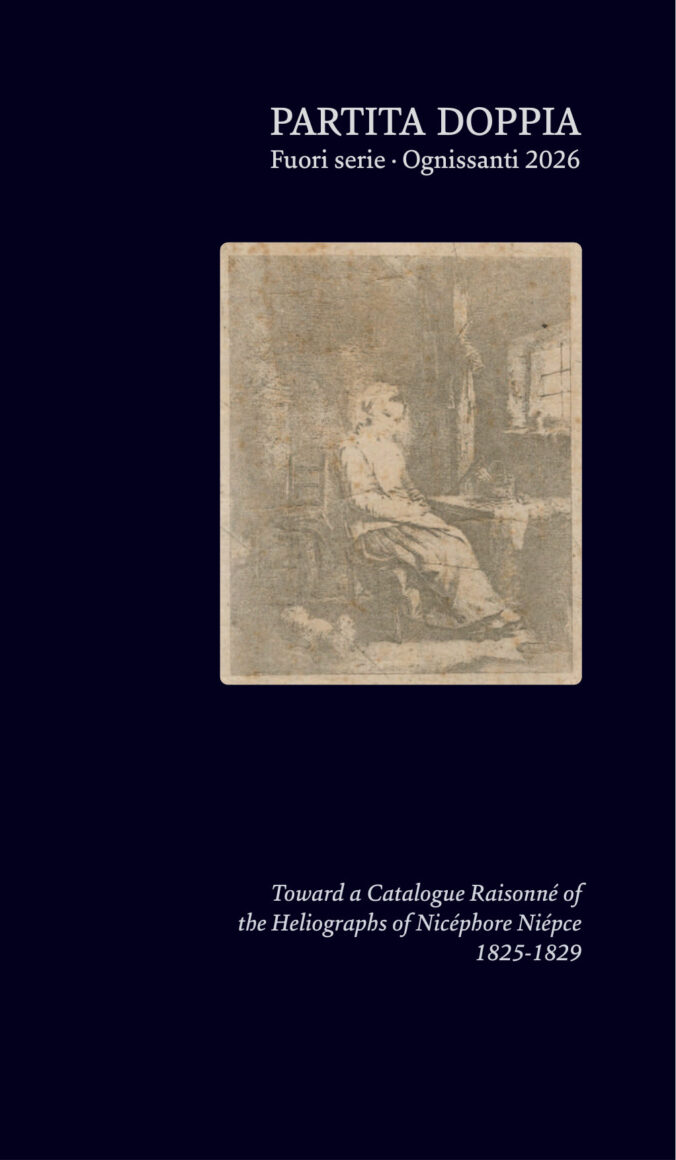
This catalogue does not line up thirty-three objects in a museum order. It follows them as they were made. To understand an invention, one has to put oneself in the inventor’s head: try, fail, change the plate (copper, pewter, tin, silver), try again. Seen that way, Nicéphore Niépce’s work falls into seven seasons, from the first trials on paper, stone and glass to the silver-plated copper of 1828-1829.
Each season has one idea that works, surrounded by several that do not. Copper for printing, pewter for seeing, an image kept in the bitumen, visible without etching, a view taken from the window, silver at last.
Season by season he improves everything, and the objects left to us fall into place: they are what remains of each step.
For Alexis Pavlovich Romanov, who one day, without a word of explanation, in thanks for a few small services to his heroic Library during perestroika, opened to me the Niépce file gathered by Joseph Hamel in the Archive of the Academy of Sciences.
For Janine Niépce, who, having examined me with care, took me in to describe and assess with her what the family had kept of Nicéphore’s heliography, before it could enter the Bibliothèque nationale.
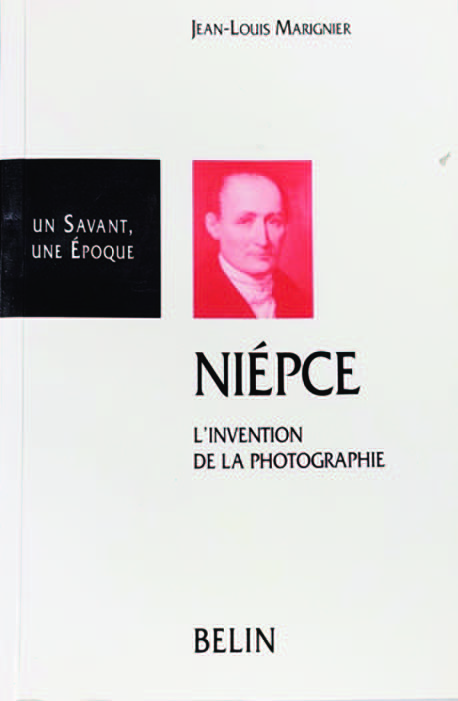
For Jean-Louis Marignier, whose Niépce. L’invention de la photographie (1999) is the safe road for anyone following Nicéphore’s adventures,
and for Jean Dhombres, who, as editor of the series Un savant, une époque, brilliantly fought the accountants and the wits for that book to see the light of day.
A Note on Method and Numbering
Jean-Louis Marignier’s book convinced me that an invention cannot be understood from its documents alone: one has first to put oneself in the frame of mind of a man founding, alone and unknown, a field now immense, which he could barely sketch; and one has to imagine words looking for themselves before they existed. Niépce had no name for what he did. He borrowed the painter’s word, peindre, for the work of light, and the engraver’s, graver, for the work of acid; héliographie came only in 1826. The first historians of the invention worked half blind. Victor Fouque in 1867 and Georges Potonniée in 1925 knew only the letters to Claude that Isidore had kept at Chalon, those that tell of failures. The letters that tell of success Isidore had given to Joseph Hamel; they went to Saint Petersburg and were published only in 1949, by Torichan Kravets. Neither of them knew the View from the Window at Le Gras, which Helmut Gernsheim found again only in 1952. They had Isidore, his labels and his memory. I met Nicéphore myself in Saint Petersburg, in the archive of the Academy of Sciences. As I remember, two registers recorded those who had asked to see the Niépce, Daguerre and Talbot files, one from 1860 to 1917, the other from 1922. The second was short: after Kravets, my name was preceded only by those of Larry J. Schaaf and one of his colleagues.
Behind this catalogue lie many years of practice, making paper and daguerreotypes, printing books and photographs, handling old objects. Hence the attention paid here to the holes pinned in a corner, the direction of an image, the shrinking of damp paper, as much as to the letters. This attempt at a catalogue raisonné records the surviving objects of Nicéphore Niépce’s heliographic work from the first plates of 1825 to the silver-plated copper of 1828-1829. Heliography, “sun-drawing”, is the name Niépce gave his process in a letter of 26 May 1826: an image formed by light in a thin ground of bitumen of Judea, spread on stone, glass or metal, which could then be etched with acid and printed in ink.
How a heliograph was made. Niépce dissolved bitumen of Judea, a natural asphalt from the shores of the Dead Sea, in an essential oil (oil of lavender, according to his later account), and spread it in a thin coating on the plate. He called this coating his vernis; it is the bitumen. Over it he laid the print he meant to reproduce, its paper first made translucent with another varnish, a spirit varnish of pine resin (see note to NN8), and left the two in the sun for hours. Gustave Le Gray would apply the same idea, with beeswax, to his waxed-paper negatives.
Where light passed through the white of the paper, the bitumen hardened; under the black lines it stayed soft, and a solvent then washed those areas away, leaving the lines as bare metal. The print was laid face down, ink against the bitumen, for the sharpest contact; the image on the plate is therefore the mirror image of the print.
From there, two roads. Either acid bit the bare lines into the metal, and the plate could be inked and printed like any etching, the press reversing the image a second time and setting it right: this is an etched plate, a matrix, which Niépce called a gravure, catalogued here as m. Or the plate was left as it was, a picture in bitumen and bare metal, seen by reflected light and never printed: this is what Niépce called a dessin, a drawing, catalogued here as d. Niépce headed the notices he wrote at Kew in November 1827 “Héliographie. Dessins & gravures.”
In French, gravure means the art, the plate and the print. Niépce used it for his etched plates: “Gravure héliographique” is engraved on the back of NN3-m2. It is translated here as matrix for the plate, and as print, engraving, etching or mezzotint for the sheet, depending on whether the technique matters.
Héliographie is Niépce’s word; héliogravure belongs to a later generation, and is used here only in quotation marks.
The catalogue comprises three kinds of objects: the etched metal plates, the impressions pulled from them on paper during Niépce’s lifetime, and the source prints he himself made translucent with varnish before laying them on the plates. Reproduced by contact, the image on the plate is the size of the image on the print laid on it; where the source sheet survives, the two can be measured against each other.
Later impressions pulled from the original plates after Niépce’s death (1833-1881), modern reconstructions, and misattributed pieces are discussed in the notes but are not numbered.
Niépce himself distinguished, in his letters, between points de vue, views taken from nature in the camera obscura, and la copie des gravures, the copying of source prints. Of the first, only the Point de vue du Gras survives. It takes its place in the sequence in the summer of 1827, among the heliographs that preceded and followed it. The views described in his correspondence but since lost are recorded in its entry.
Each composition is given a number, preceded by the initials NN. Within an entry the initials are dropped: m1, p2; a reference to another entry cites them fully, NN6-m1. A lower-case letter then specifies the kind of object; the letters were chosen to work equally well in English, French and Italian:
t, transparency (transparent, trasparente): the source print Niépce made translucent with varnish;
m, matrix (matrice, matrice): a plate etched to be printed;
d, drawing (dessin héliographique, disegno eliografico): a plate whose image was meant to be looked at, not to be printed;
p, print (épreuve sur papier, prova di stampa): an impression in ink on paper, pulled from a matrix, also referred to as a photo-etching.
A figure distinguishes the surviving examples of one kind: NN2-p1 and NN2-p2 are the two known prints of the Jeune fille. It counts them; it does not date them. A shared number asserts a common subject, never a common origin: NN6-p1 is not claimed to have been pulled from NN6-m1. Where a print can be matched to its plate, the entry says so and gives the evidence.
The compositions follow the order in which the letters date them, a date written in a letter being the one fixed point. NN1 is the Cheval avec son conducteur, first mentioned by Niépce on 7 August 1825; this does not mean that its plate was made before that of the Jeune fille, and nothing permits us to say which came first.
Subjects that are not mentioned in the correspondence are placed according to their support or format, and the reasons are given in their entries. Where a date has been handed down, most often by Isidore Niépce on the labels and frames he inscribed, it is reported as received, and contested only where the letters contradict it. Labels and inscriptions are given to Isidore by comparison with his signed dedication on NN6-p1, and with the inscription he claims as his own on NN11-d2 (“tracée par moi sur le métal même”); labels naming him in the third person (“Don de Mr Isidore Niepce”) are by other hands.
A translucent sheet is numbered only when it survives or is documented; every plate made by contact presupposes one. Niépce thought of reproducing prints with the megascope, through a lens (1826-1827); no plate made that way is known. Published states of the source prints Niépce reproduced, found today in other collections, are illustrated for comparison but are not numbered.
Lost objects are printed in grey, their numbers in square brackets.
Numbers, once printed, tend to outlive the certainties of those who chose them. These have been chosen to survive revision: a correction will refine an entry; it should not renumber the catalogue. A composition found later will take the next free number; a newly found example of a known composition, the next figure; a lost object, if found, keeps its number, without brackets.
Inventory numbers are given for objects in the Musée Nicéphore Niépce, where several plates of one subject would otherwise be confused, and shelfmarks for those in the Bibliothèque nationale de France, where they are needed to find the sheet. Quotations from letters are given in modern spelling; inscriptions on the objects, and titles, keep their original form.
The portraits of Nicéphore Niépce, which illustrate these chapters, will be the subject of a separate study.
Serge Plantureux, Senigallia, 30 October 2026
The Seven Seasons
| Season | The idea that works | What still fails |
|---|---|---|
| I. 1816-1824, paper, stone and glass | A print made translucent with varnish, laid on the bitumen and left in the sun: “the method of every heliograph in this catalogue” | Nicéphore alone can see the image: the lithographer sends the stone back |
| II. 1825, copper | “Peindre et graver tour à tour” (paint and etch in turn), until the line holds the ink: the first prints, pulled in Dijon, can be shown | The Dijon proofs on paper lack “la netteté et la correction désirées” (the sharpness and accuracy he wanted) |
| III. Spring 1826, pewter | The white metal of music engravers, which makes the image “beaucoup plus nette”, much sharper | Pewter is soft: the plates take the ink imperfectly |
| IV. Summer and autumn 1826, Curley’s parcel | An abundance of models, and nearly pure tin | The plates are still etched to take the ink |
| V. Spring 1827, Lemaître’s parcel | The image kept in the bitumen, visible without etching: the drawing (dessin), a plate to be looked at, not printed | Still slow, and not yet adapted to the camera obscura |
| VI. Summer 1827, the window | The views from nature: “Mon procédé est excellent” (my process is excellent) | “Un peu de vague” (a slight blur); long exposures, objects not rendered “avec une égale netteté” (with equal sharpness) |
| VII. 1828-1829, silver-plated copper | “Dessin sur argent plaqué”, a drawing on silver-plated copper, the metal of the daguerreotype | To be continued with Daguerre after the partnership (1829), without preserved artefacts until Niépce’s death in 1833 |
I. 1816-1824: Experiments on Paper, Stone and Glass
II. 1825: Copper. The First Images Shown to the World
NN1 · Cheval avec son conducteur · NN2 · Jeune Fille à la quenouille
III. Spring 1826: Pewter, the Metal of Music Engravers
NN3 · Sainte Famille · NN4 · Petit Paysage dans un octogone
IV. Summer and Autumn 1826: Curley’s Parcel and Nearly Pure Tin
NN5 · Le Prisonnier, les mains attachées · NN6 · Cardinal d’Amboise · NN7 · Vue d’une ruine près Fréjus · NN8 · Portrait d’Estienne Pasquier · NN9 · Paysage en tondo
V. Spring 1827: Lemaître’s Parcel, Images Visible without Etching
NN10 · Trois Personnages dans un paysage · NN11 · Le Christ portant sa croix · NN12 · Le Joueur, after Charlet · NN13 · Un clair de lune, after Daguerre
VI. Summer 1827: “I am like Columbus”. The View from the Window
NN14 · Point de vue du Gras
VII. 1828-1829: Silver-Plated Copper, the Metal of the Daguerreotype
NN15 · Trois Figures en costumes méditerranéens · NN16 · L’Ermite, ou frère Luce
Afterword: What Is Kept, What Is Lost
Laisser un commentaire