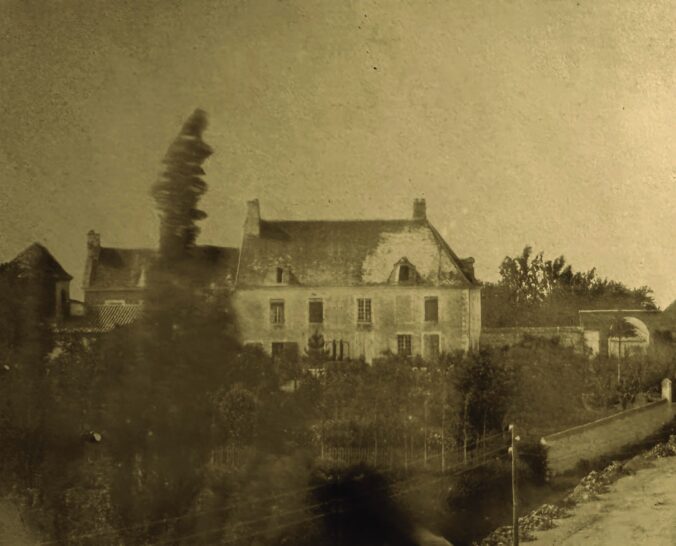
Nothing remains but letters, and a camera
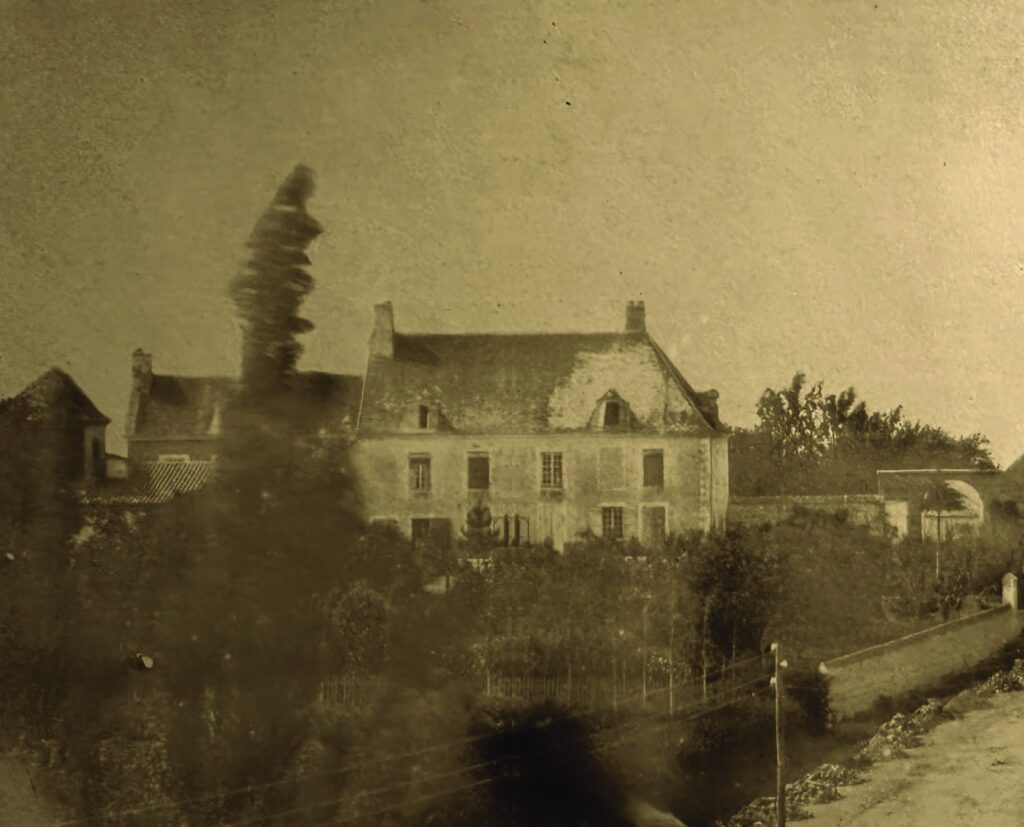
Twenty years after Niépce’s death, the house where he made his experiments stands behind an overgrown garden.
Telegraph wires run along the road; the railway from Paris to Lyon is about to pass a few yards away. Petiot-Groffier was a Chalon lawyer turned sugar-beet refiner, who brought the champagne method to Burgundy wines, sat as a deputy under Louis-Philippe, and was mayor of Chalon when Niépce died, in July 1833. He came to photography in 1841 under the supervision of Richebourg, whose “Supplément à la notice pour l’usage du daguerréotype” (Supplement to the instructions for the use of the daguerreotype) was written for him before his departure for India that summer, and became one of the early amateurs of the paper negative with the help of Ferrier and Baldus. No earlier photograph of the lonely house is known.
His laboratory, furnished by Charles Chevalier, the optician who had sold Niépce his lenses, is kept today in that house.
Niépce had been trying to hold the image of the camera obscura since 1816, when the window of his workroom appeared on paper and would not stay. By 1822 Claude, in London, was congratulating him on a view he had only read about, and waiting for “un résultat complet et définitif” (a complete and definitive result).
In May 1823 he bought from the printer Dejussieu “une pierre lithographique d’Allemagne d’excellente qualité” (a German lithographic stone of excellent quality), had it cut, and kept the offcuts “pour des épreuves en petit” (for small trials). On 1 July he told Claude that he had varnished an aquatint “et l’avoir rendue parfaitement transparente” (and made it perfectly transparent), laid it on the stone, and let the light do the rest: the method behind every heliograph in this catalogue, whatever the support, two years before the first of them (NN1). In the same letter, on his brother’s advice, he promised to say nothing more of his processes in writing. He kept his word. From now on the letters say what he made, rarely how.
A year later he sent a stone to be printed, having warned, through Carbillet, that it was to be printed “comme les planches de cuivre” (like copper plates). The lithographer, finding on it “ni dessin, ni eau gommée” (neither drawing nor gum water), decided that the lithographic method had been badly applied, and stopped work to ask. It was the first time a professional looked at a heliograph, and he saw nothing. On 16 September 1824 he announced the view from Claude’s room, on the Gras side, the angle of the view he would take again in 1827 (NN14), made with his largest camera on his largest stone: “une netteté, une fidélité étonnantes” (an astonishing sharpness and fidelity), visible only when the stone was looked at obliquely, “et cet effet, je puis le dire, mon cher ami, a vraiment quelque chose de magique” (and this effect, I can say, my dear friend, truly has something magical about it). A smaller view on glass had failed, “trop faible de ton” (too weak in tone); he started it again. Three weeks later the acid bit the stone only faintly, and on the same evening the bankers Coste wrote to ask for their money. The next summer he turned to copper, which he had already learned to etch.
To this year, or the next, may belong the portrait of Pope Pius VII on glass, given to General Poncet du Maupas, a cousin by marriage who had championed the Niépce brothers since their engine of 1807, portrait supposedly broken soon after. Isidore dated the portrait 1822, as he often dated things a little earlier than they were. The letters allow it in 1824, the year Niépce first wrote of views “sur verre” (on glass); the general’s death, on 5 June 1825, allows nothing later. Of all this, no stone and no glass survive. The stones probably went back to the next experiment; the glass broke.
Only the letters remain, and perhaps the camera that saw the Gras.
Notes. Niépce to Claude, 5 May and 1 July 1823, 13 June, 16 September and 8 October 1824 (Bonnet and Marignier 2003, nos 374, 375, 382, 384, 386).
Claude to Niépce, 19 July 1822 (no. 366).
On the camera: Bonnet and Marignier 2003, note to no. 384, which identifies the largest camera with the “chambre de la découverte” (camera of the discovery) at the Musée Nicéphore Niépce.
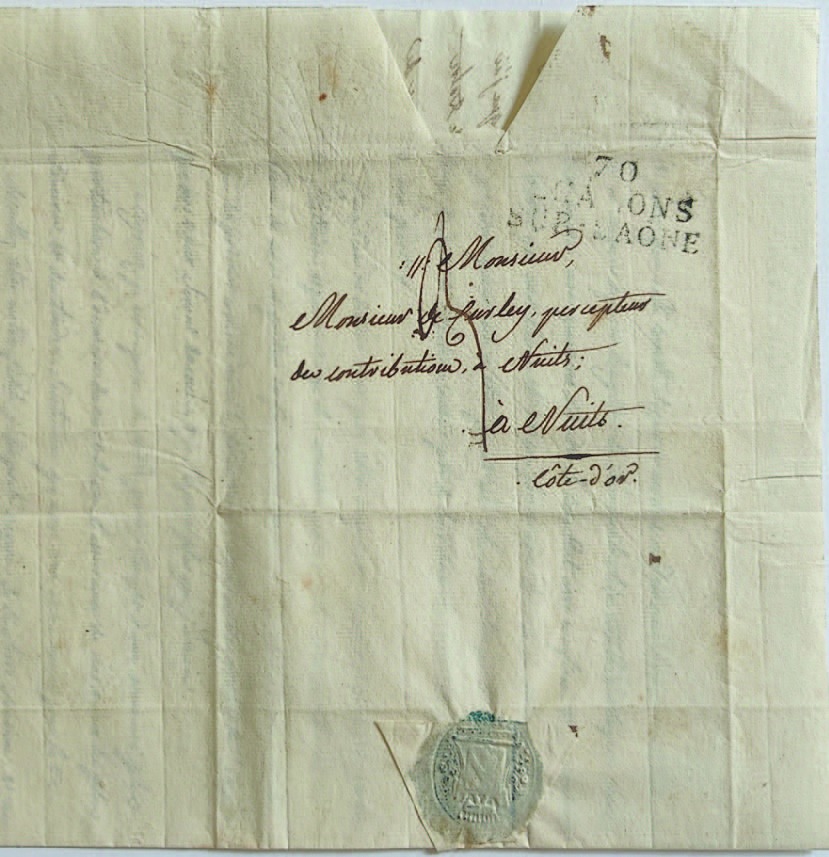
Before the first heliograph, the family business was a machine. Claude had been in England since 1817, and Nicéphore paid for his work with borrowed money. The interest on a note of 2,000 francs falls due “après-demain, 1er janvier” (the day after tomorrow, 1 January), and Curley, the tax collector, is asked to forward it. Then Nicéphore copies out his brother’s latest letter, for the cousin who is paying: the machine is “fort avancée, mais […] point encore finie” (well advanced, but […] not yet finished), Claude has long had “la démonstration mathématique” (the mathematical demonstration), and the world will see that his discovery “est conforme aux lois de la Mécanique, et que par conséquent elle n’était point une chimère” (conforms to the laws of mechanics, and was therefore no chimera). The pyréolophore of 1807, an internal combustion engine, had been Nicéphore’s idea, shared with his elder brother as custom required; in England Claude kept perfecting a would-be perpetual motion machine, and Nicéphore kept paying. Even General Poncet, who had championed the engine of 1807, thought Claude’s machine “impossible”.*
* Poncet to Gillet de Laumont, 13 April 1825, Bonnet and Marignier 2003, no. 390
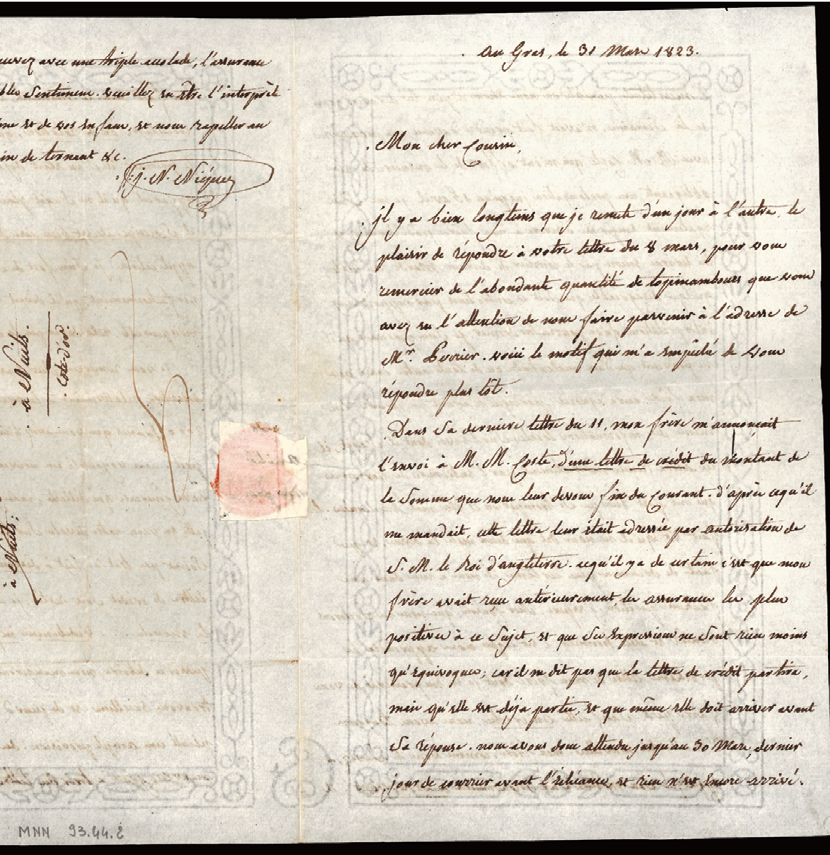
The letter opens with thanks for “l’abondante quantité de topinambours” (the abundant quantity of Jerusalem artichokes) sent from Nuits, and turns at once to money.
Claude has announced from London a letter of credit to the bankers Coste, covering the sum due at the end of the month, and sent, he says, “par autorisation de S. M. le Roi d’Angleterre” (by authorization of H. M. the King of England). Nicéphore wants to believe it: his brother’s words are “rien moins qu’équivoques” (anything but equivocal), the letter is not about to leave, it has left. So the family waited, until 30 March, the last post before the due date. “Rien n’est encore arrivé.” (Nothing has arrived yet.)
Three months later, on the advice of the same brother, Nicéphore would stop describing his processes in his letters. He went on describing his debts. Claude died at Kew on 5 February 1828,* his machine unfinished; the family debts had reached some 170,000 francs.
* Buried at Kew on 11 February (Bonnet and Marignier 2003, note to no. 456; Gernsheim gives 10 February).
Laisser un commentaire