Pewter, the Metal of Music Engravers
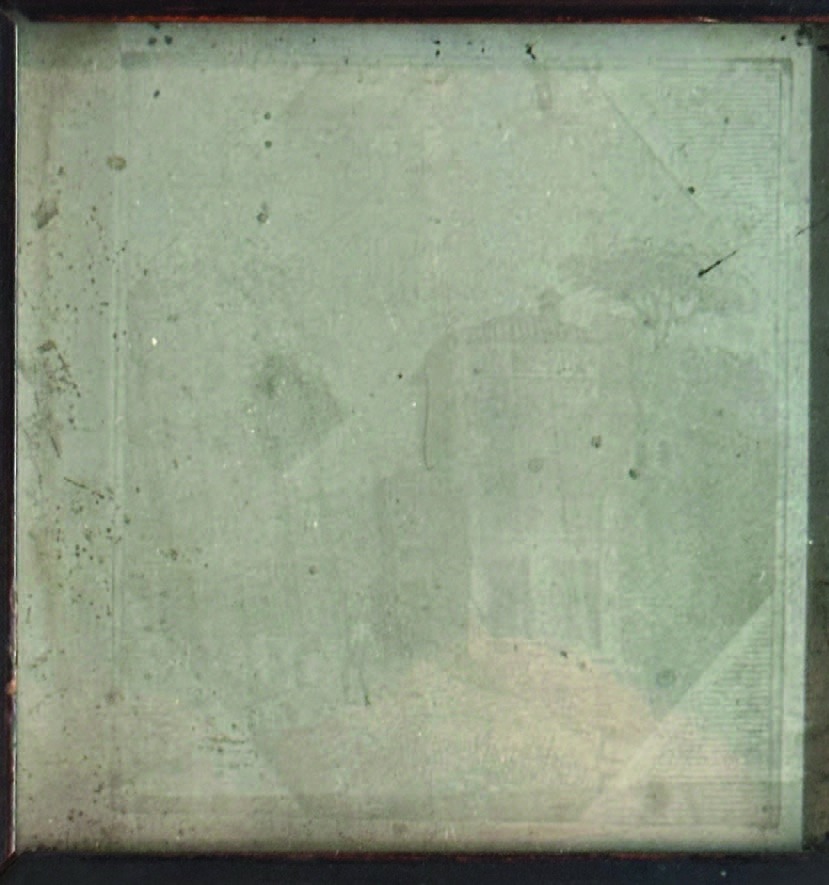
NN3 · Sainte Famille · NN4 · Petit Paysage dans un octogone
Nicéphore à Isidore et Eugénie, Au Gras, 26 mai 1826
“Mes travaux héliographiques sont en pleine activité. J’ai fait venir de nouvelles planches d’étain: ce métal convient mieux à mon objet, principalement pour les points de vue d’après nature, parce que réfléchissant davantage la lumière, l’image paraît beaucoup plus nette: je me félicite donc de cette heureuse inspiration. […] Lorsque vous serez à Grenoble n’oubliez pas, je vous prie, la demi-douzaine de peaux de chevreaux dont on fait les gants de femme, pour mes tampons.”
“My heliographic work is in full swing. I have sent for new tin plates: this metal suits my purpose better, chiefly for views from nature, because, reflecting more light, the image appears much sharper: so I am pleased with this happy inspiration. […] When you are in Grenoble, please do not forget the half dozen kidskins of the kind used for ladies’ gloves, for my dabbers.”
Nicéphore à Daguerre, Chalon, 4 juin 1827
“Vous me demanderez probablement, Monsieur, pourquoi je grave sur étain au lieu de graver sur cuivre. Je me suis bien servi également de ce dernier métal; mais pour mes premiers essais, j’ai dû préférer l’étain, dont je m’étais d’ailleurs procuré quelques planches destinées à mes expériences dans la chambre noire; la blancheur éclatante de ce métal le rendant bien plus propre à réfléchir l’image des objets représentés.”*
“You will probably ask me, Sir, why I engrave on tin instead of on copper. I have indeed used the latter metal as well; but for my first trials I had to prefer tin, of which I had moreover obtained a few plates intended for my experiments in the camera obscura, the brilliant whiteness of this metal making it much better suited to reflect the image of the objects represented.”
Pewter was the metal of music engravers, not of those who reproduced pictures**. Niépce had bought it for its whiteness: a bright plate made the image in the camera brighter, and he meant to look at the image, not to print it. In the spring of 1826 he used these plates to reproduce prints as well, and kept to them for his first experiments. On 26 May he told Isidore, who was traveling in the south, that his heliographic work was “en pleine activité” (in full swing), that he had sent for “nouvelles planches d’étain” (new tin plates), and that he congratulated himself on this “heureuse inspiration” (happy inspiration). In the same letter he asked his son to bring back from Grenoble half a dozen kidskins, of the kind used for ladies’ gloves, for the dabbers with which he spread his varnish. Photography began on a glover’s leather.
The two metals of that spring can still be told apart. The first plates were an alloy of tin, lead and antimony; the new ones of May were nearly pure tin. The Sainte Famille (NN3), cut from the alloy, belongs to the first; the Cardinal (NN6), at 98.5 % tin, to the second. When Niépce finally sent Daguerre an etched plate, in June 1827, it was the Sainte Famille, and he had to admit that it was “point récent” (not recent): “il date du printemps dernier” (it dates from last spring), by which he meant 1826. Daguerre had asked for a print, and received a matrix a year old.
* Bonnet et Marignier 2003, nos 399 et 418
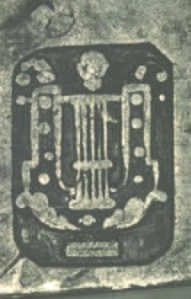
** The antimony, found in both Sainte Famille matrices and in no other plate, and the lyre punched on both, point to the same source: plates made for engravers of music.
NN3 · Sainte Famille
Jesus Maria Joseph (The Return from Egypt)
Spring 1826 (pewter plates) · February 1827 (print on paper, lost)
t1 · Engraving by Étienne Desrochers after Charles Le Brun, “Jesus Maria Joseph”, “Se vend à Paris chez Bazin, rue St Séverin” (sold in Paris by Bazin, rue Saint-Séverin), made translucent with varnish by Niépce; holes in three corners. 224×182 mm. Chalon-sur-Saône, Musée Nicéphore Niépce.
Provenance. Isidore Niépce; Musée de Chalon; missing c. 1976-1999; Musée Nicéphore Niépce, July 2000
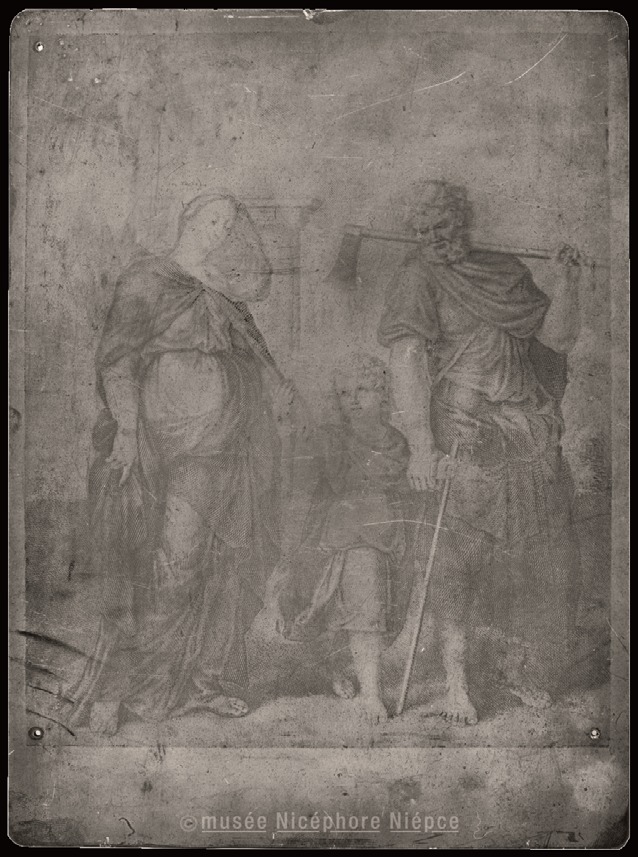
m1 · Plate of tin-lead-antimony alloy (tin 57 %, lead 39 %, antimony 2.9 %), etched, 267×198 mm; holes in three corners; on the back, a maker’s hallmark in the form of a five-string lyre. Chalon-sur-Saône, Musée Nicéphore Niépce, inv. 1975.149.2.8 (B. Lavédrine, plates analysis, P2A).
Provenance. Isidore Niépce; Musée de Chalon; missing c. 1976-1999; Musée Nicéphore Niépce, July 2000
m2 · Plate of tin-lead-antimony alloy (tin 51.4 %, lead 44.5 %, antimony 3.2 %), etched, 267×199 mm; holes in three corners; the same lyre maker’s hallmark. Engraved on the back: “Gravure héliographique, / Par Mr N. Niépce. / L’auteur à Mr Daguerre.” (Heliographic engraving, by Mr. N. Niépce. The author to Mr. Daguerre.) Paris, Société française de photographie, on deposit with the BnF (B. Lavédrine, plates analysis, P2B).
Provenance. Sent by Niépce to Daguerre, June 1827; gift of M. Forest to Société française de photographie, 1875.
[p1] · Print on paper, pulled under Lemaître’s eye in Paris, February-March 1827, from one of the two plates; sent back to Niépce with the plates on 5 March 1827. Lost.
Source print. The engraving itself (t1): Étienne Desrochers after Charles Le Brun, Jesus Maria Joseph, Paris, Bazin. Identified by Isabelle Evrard, BnF. The date. In June 1827, Niépce wrote to Daguerre that the plate was “point récent” (not recent): “il date du printemps dernier” (it dates from last spring). Since one of the two had been in Lemaître’s possession as early as February 1827, this refers to the spring of 1826. The alloy agrees: it is not the pure tin purchased in May 1826.
One engraving, two plates. The corner holes, on the transparent sheet and on both plates, show that the same sheet was pinned twice.
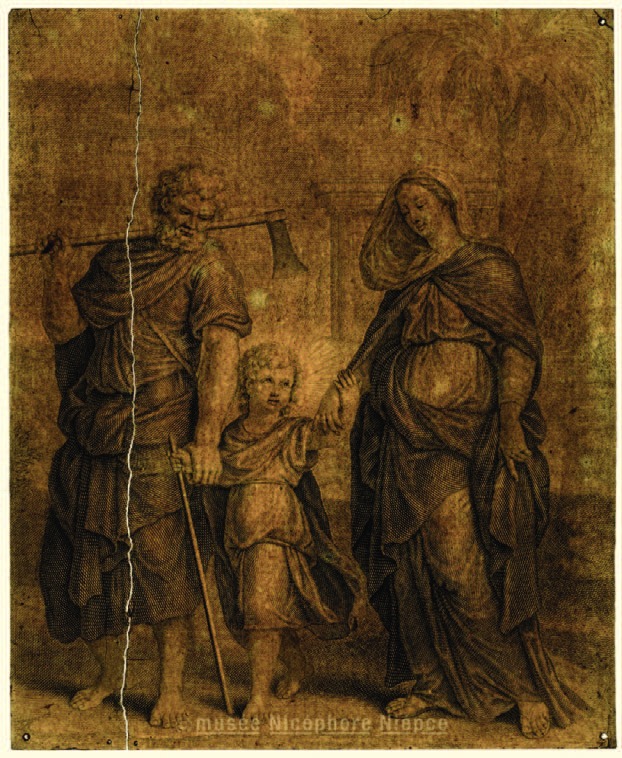
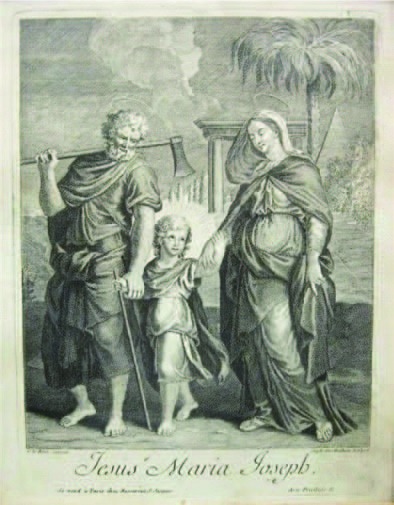
Lemaître’s plate. He had one of the two in February and March 1827;* the letters do not say which. The plates suggest it: the lines of m1 are still filled with a dark matter, most probably ink, while m2, engraved on the back for Daguerre, is bare. Niépce would hardly have given Daguerre a plate that had been printed.
Daguerre’s plate. Daguerre had asked for a result. On 4 June 1827 Niépce sent him one of the two plates, with a print pulled from it, and apologized for both:
Nicéphore à Daguerre, Chalon, 4 juin 1827
“Vous recevrez presque en même tems que ma lettre, une caisse contenant une planche d’étain, gravée d’après mes procédés héliographiques, et une épreuve de cette même planche, très-défectueuse et beaucoup trop faible. Vous jugerez par là, que j’ai besoin de toute votre indulgence, et que si je me suis enfin décidé à vous adresser cet envoi, c’est uniquement pour répondre au désir que vous avez bien voulu me témoigner. Je crois malgré cela, que ce genre d’application n’est point à dédaigner, puisque j’ai pu, quoique étranger à l’art du dessin et de la gravure, obtenir un semblable résultat.”
“You will receive, almost at the same time as my letter, a case containing a tin plate, engraved by my heliographic processes, and a print from that same plate, very defective and much too faint. You will judge from this that I need all your indulgence, and that if I have at last decided to send it to you, it is only to answer the wish you were kind enough to express. I believe nevertheless that this kind of application is not to be despised, since I have been able, though a stranger to the art of drawing and engraving, to obtain such a result.”
Daguerre’s answer is lost. His judgment is known only from what Niépce reported to Lemaître seven weeks later:
Nicéphore à Lemaître, Chalon, 24 juillet 1827
“Depuis la dernière lettre que vous avez reçue de moi, je ne me suis plus occupé de gravure. […] Ainsi que je vous l’ai mandé dans le temps, Monsieur, j’ai envoyé à Monsieur Daguerre un de mes essais de gravure ; et j’ai choisi la Ste. Famille. Sa critique a été impartiale, à ce que je crois, mais sévère ; elle m’a rappellé ce que vous m’aviez fait l’honneur de me dire à ce sujet ; ce qui n’a pas peu contribué à ralentir mon zèle. Je me suis donc livré à une autre application qui n’exigeât pas l’emploi des acides.”
“Since the last letter you received from me, I have no longer occupied myself with engraving. […] As I told you at the time, Sir, I sent Monsieur Daguerre one of my engraving trials, and I chose the Holy Family. His criticism was impartial, I believe, but severe; it reminded me of what you had done me the honor of telling me on the subject, which did not a little to slow my zeal. So I turned to another application, one that would not require the use of acids.”
The criticism was not new. Daguerre had first written to Niépce in January 1826; that letter is lost. A second, also lost, reached Chalon at the beginning of February 1827, and Niépce reported it to Lemaître:
Nicéphore à Lemaître, Chalon, 2 février 1827
“P.S. Connaissez-vous, Monsieur, un des inventeurs du Diorama, Mr. Daguerre ? Voici pourquoi je vous fais cette question. Ce Monsieur, ayant été informé, je ne sais trop comment, de l’objet de mes recherches, m’écrivit l’an passé dans le courant de janvier, pour me faire savoir que depuis fort longtems, il s’occupait du même objet, et pour me demander si j’avais été plus heureux que lui, dans mes résultats. […] Je ne la reçois qu’aujourd’hui, c’est à dire après un intervalle de plus d’un an ; et il me l’adresse uniquement pour savoir où j’en suis, et pour me prier de lui faire passer une épreuve, bien qu’il doute qu’il soit possible d’être entièrement satisfait des ombres par ce procédé de gravure ; ce qui lui fait te[n]ter des recherches dans une autre application, tenant plustôt à la perfection qu’a la multiplicité. Je vais le laisser dans la voie de la perfection, et par une réponse laconique, couper court à des relations dont la multiplicité, comme vous pouvez bien le penser, Monsieur, pourrait me devenir également désagréable et fatiguante.”
“P.S. Do you know, Sir, one of the inventors of the Diorama, Mr. Daguerre? This is why I ask. This gentleman, having been informed, I hardly know how, of the object of my research, wrote to me last year in the course of January, to let me know that he had long been occupied with the same object, and to ask whether I had been more fortunate than he in my results. […] I receive his answer only today, that is, after an interval of more than a year; and he sends it solely to learn how far I have got, and to ask me to send him a print, although he doubts that one can ever be entirely satisfied with the shadows by this process of engraving; which leads him to try his researches in another application, aiming at perfection rather than multiplicity. I shall leave him on the road to perfection and, by a laconic reply, cut short relations whose multiplicity, as you may well imagine, Sir, might become equally disagreeable and tiresome to me.”
Nicéphore à Daguerre, Chalon, 2 février 1827
“J’ai perfectionné d’une manière sensible, mes procédés pour la gravure sur métal ; mais les résultats que j’ai obtenus ne m’ayant point encore fourni d’épreuves assez correctes, je ne puis satisfaire le désir que vous me témoignez. Je dois sans doute, le regretter plus pour moi que pour vous, Monsieur, puisque le mode d’application auquel vous vous livrez, est tout différent, et vous promet un degré de supériorité que ne comporterait pas celui de la gravure ; cequi ne m’empêche pas de vous souhaiter tout le succès que vous pouvez ambitionner.”
“I have improved my processes for engraving on metal appreciably; but as the results I have obtained have not yet given me prints correct enough, I cannot satisfy the wish you express. No doubt I must regret it more for my own sake than for yours, Sir, since the mode of application to which you devote yourself is quite different, and promises you a degree of superiority that engraving would not allow; which does not prevent me from wishing you all the success you may aspire to.”
Lemaître, in his reply of 7 February, approved Niépce’s intention to break off, and found the plates too faintly bitten. A fortnight later Niépce wrote to him that, if he had to give up multiplying prints, he would at least have an exact copy of nature (see NN11): Daguerre’s “perfection rather than multiplicity”, in Niépce’s own words. In June the Sainte Famille went to Daguerre all the same, and the verdict came back unchanged. Two years later, on the eve of their partnership, Daguerre was still of the same mind:
Daguerre à Nicéphore, Paris, 12 octobre 1829
“[…] vous savez Monsieur que je ne suis pas partisan de l’application que vous en faites à la gravure, parcequ’il me semble que vous devez avoir sur votre matiere absorbante, un resultat plus parfait et qui est probablement détruit en partie par l’application de l’acide meme le plus faible.”
“[…] you know, Sir, that I am no partisan of the application you make of it to engraving, because it seems to me that you must have on your absorbent substance a more perfect result, which is probably destroyed in part by the application of even the weakest acid.”
Notes. Niépce to Lemaître, 2 February 1827; Niépce to Daguerre, 2 February 1827; Lemaître to Niépce, 7 February 1827; Niépce to Daguerre, 4 June 1827; Niépce to Lemaître, 24 July 1827; Daguerre to Niépce, 12 October 1829 (Bonnet and Marignier 2003, nos 406, 407, 409, 418, 421 and 497). Daguerre’s letters of January 1826 and of early 1827 are lost (no. 406, nn. 2 and 5). Marignier underlines the irony of Niépce’s answer (no. 407, n. 3), and observes that for Daguerre the whole idea long came down to the heliographic plate shown to him in June 1827 (no. 497, n. 1). The plate sent is the SFP Sainte Famille, m2 (no. 417, n. 1).
* Lemaître, who had doubted on 7 February that the plate would print at all, admitted on 5 March that it had given “un peu plus que je ne m’attendais” (a little more than I expected)
NN4 · Petit Paysage dans un octogone
Small Landscape with a House
Spring-Summer 1826 · No prints
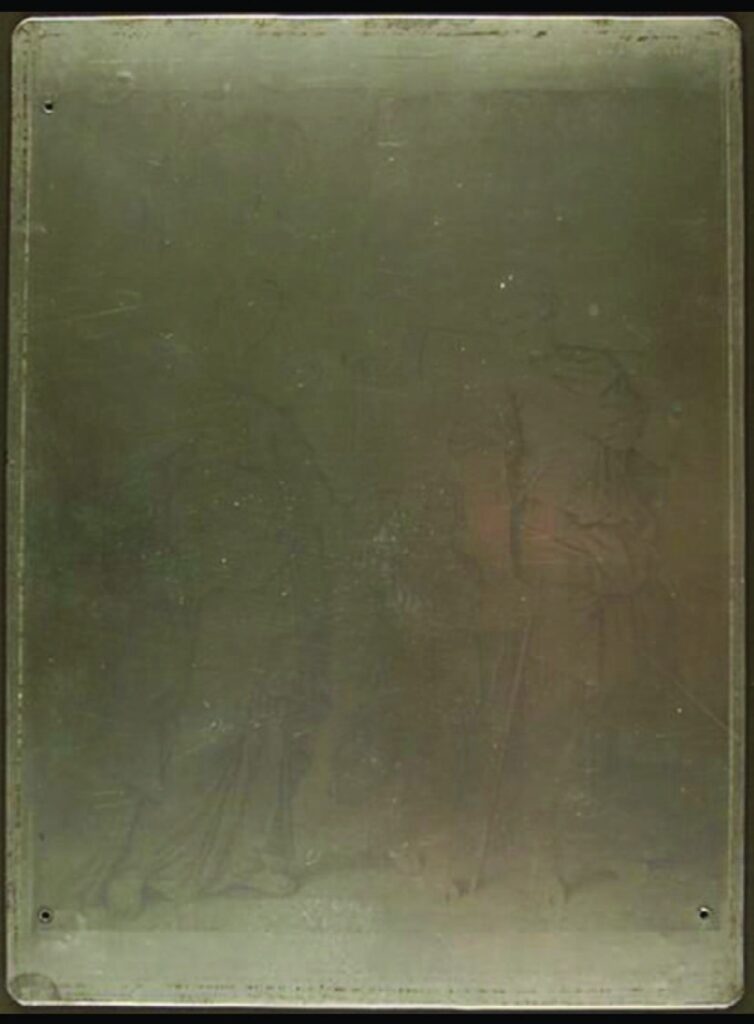
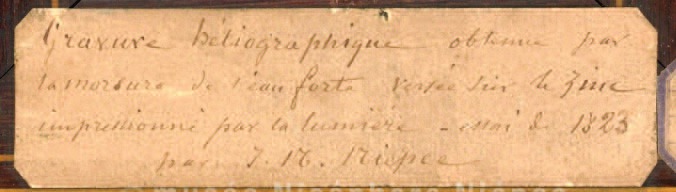
m1 · Plate of metal (described as zinc on Isidore’s label, not analysed), etched, 80×80 mm, the image within an octagon. In an old frame, with a label in ink: “Gravure héliographique obtenue par la morsure de l’eau-forte versée sur le zinc impressionné par la lumière, essai de 182[5, corrected to 3] par J. N. Niépce” (heliographic engraving obtained by the biting of acid poured on zinc impressed by light, trial of 182[5] by J. N. Niépce), the last digit of the date altered in the same hand, a “3” written over the “5”. Chalon-sur-Saône, Musée Nicéphore Niépce, inv. 1975.149.2.13.
Provenance. Isidore Niépce; Musée de Chalon-sur-Saône (Musée Vivant Denon), [1861]; missing c. 1976-1999, at the Société d’histoire et d’archéologie de Chalon-sur-Saône, within the Musée Vivant Denon; found again in 1999 (Marignier); Musée Nicéphore Niépce, July 2000.
Source print. Not identified. The tree and the low-pitched roof suggest an Italianate landscape.
No letter mentions this plate. Its size, 80×80 mm, is too small for a plate meant for printing, and might suggest 1825; but the only metal Niépce names for that year is copper, which this plate does not appear to be. It is placed at the head of the first plates of 1826 until an analysis decides.
Isidore’s label dates the plate to 1825, and the date was later pushed back to 1823. The Paysage en tondo (NN9) bears nearly the same words in the same hand.
Written a generation after the experiments, by a son defending his father’s priority, these labels are evidence of that defense rather than of the plates.
For a quarter of a century the plate did not leave the building of the Musée Vivant Denon; it simply stopped being seen.
Laisser un commentaire