NN10 · Trois Personnages dans un paysage · NN11 · Le Christ portant sa croix · NN12 · Le Joueur, after Charlet · NN13 · Un Clair de lune, after Daguerre.
From now on the plates are no longer etched: the image stays in the bitumen, to be looked at rather than printed, what Niépce called a dessin. Lemaître to Niépce, 28 March 1827: “Vous recevrez presque aussitôt que ma lettre, huit gravures, quatre eau-fortes et burin et quatre aquatinta et manière noire, comme il existe peu de petites gravures de ce dernier genre je n’ai presque pas eu à choisir, j’ai été plus heureux pour les gravures au burin qui sont fort belles et d’un prix très modique en raison de leur beauté, ces 8 gravures coûtent 13 F. Vous trouverez le prix de chacune coté au bas de leur marge. Ces gravures sont variées autant que possible pour leur format. Le papier est fin et je désire qu’il soit assez mince pour votre opération. J’ai choisi parmi les épreuves celles qui se trouvaient sur le papier le moins épais; car on imprime maintenant presque toutes les estampes sur du papier très fort; néanmoins je crois qu’il peut être rendu très transparent. […] Il n’y a de frais accessoires dont vous me parlez que cinq épreuves que je vous ai envoyées et que j’ai fait tirer pour 1 f.”
“You will receive, almost as soon as my letter, eight engravings, four etchings and line engravings and four aquatints and mezzotints; as there are few small engravings of this last kind, I had almost no choice; I was luckier with the line engravings, which are very fine and very modestly priced given their beauty; these 8 engravings cost 13 F. You will find the price of each marked at the foot of its margin. These engravings are as varied in format as possible. The paper is thin, and I hope it is thin enough for your operation. I chose among the impressions those on the least thick paper, for nearly all prints are now pulled on very heavy paper; nevertheless I believe it can be made very transparent. […] The only incidental costs you mention are five proofs that I sent you and had pulled for 1 f.”
| L’amour, Desenne | 2,00 F |
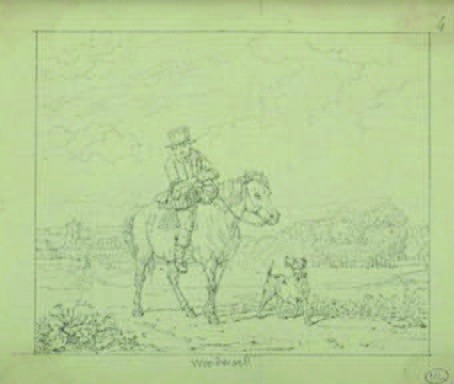
| Le commissionnaire tenté [after Woodward] | 2,00 F |
| Le Christ [portant sa croix, NN11] | 1,50 F |
| Didon | 1,50 F |
| Intérieur aqua-tinta [Un clair de lune, after Daguerre? NN13?] | 2,00 F |
| Le joueur [after Charlet, NN12?] | 2,00 F |
| Paysage [avec trois personnages, NN10 ?] | 1,00 F |
| Portrait | 1,00 F |
| Total | 13,00 F |
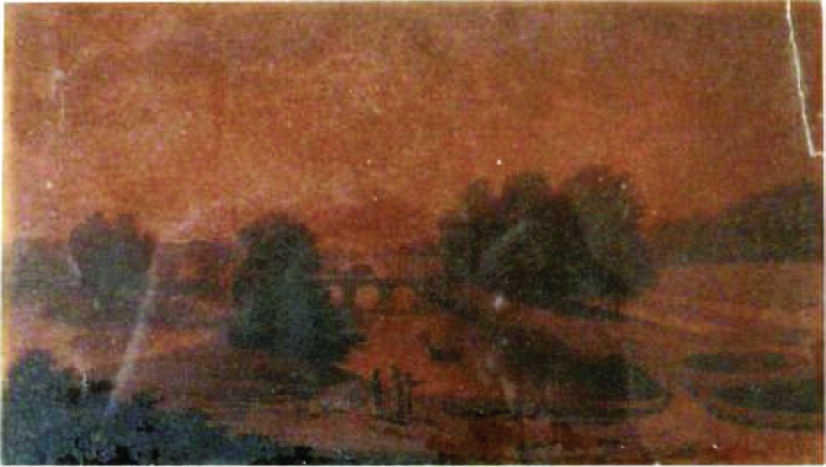
NN10 · Trois Personnages dans un paysage
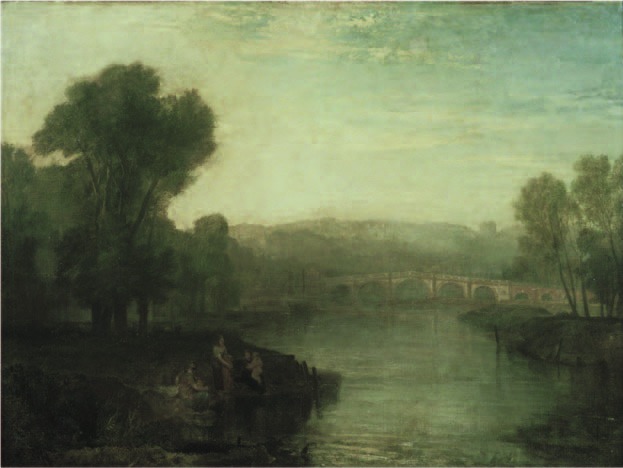
River Landscape with a Bridge and Three Figures
Spring 1827 (transparency) · No plate · No prints
t1 · Engraving, a landscape with three figures before a river crossed by a bridge and a footbridge, made translucent with varnish by Niépce, spring 1827. 95×165 mm. Paris, Bibliothèque nationale de France, Estampes et photographie.
Provenance. Probably among the eight prints Lemaître sent from Paris on 28 March 1827; given by the last direct descendant of Nicéphore Niépce to bear the name, who had no children, to Janine Niépce (1921-2007), Paris, whom he chose for her strength of character, as she told the author at length while he worked with her on her heliographic archive; Bibliothèque nationale de France.
Source print. The engraving is cropped (t1). Not identified. A river landscape with a bridge of three arches, in the English manner of the 1810s and 1820s.
Literature. Bulletin de la Société française de photographie, March 1920, p. 60; Bibliothèque nationale 1967, no. 74; Marignier 1999, p. 581, and pl. II. On 17 March 1827, having seen his first proofs printed by a professional, Niépce asked Lemaître for six or eight engravings, “tant paysages que figures et intérieurs, parmi lesquelles quelques-unes à l’aquatinta” (landscapes as well as figures and interiors, some of them in aquatint), on thin paper, “afin d’être rendu transparent à l’aide du vernis” (so that it can be made transparent with varnish), and no larger than his plates. Eleven days later the parcel left Paris: eight prints for 13 francs, the price of each marked at the foot of its margin. Among them, at 1 franc, a “Paysage” (Landscape).
This small landscape, three figures on a riverbank, a bridge and a footbridge behind them, is in all likelihood that sheet. It was varnished, like the others, and then nothing happened. No plate of it is known, and no letter mentions it again.
Of Niépce’s translucent sheets that survive without a heliograph, it is the last in date. Of the eight prints Lemaître chose, three can be followed on to tin: the Christ (NN11), the Joueur (NN12), and perhaps the Clair de lune (NN13). The others, L’Amour, Didon, Le Commissionnaire tenté, the Portrait, have left no trace on metal, and this landscape has left none beyond its own varnished sheet.
NN11 · Le Christ portant sa croix
Christ Bearing the Cross
June 1827 (tin plates) · Transparency lost · No prints
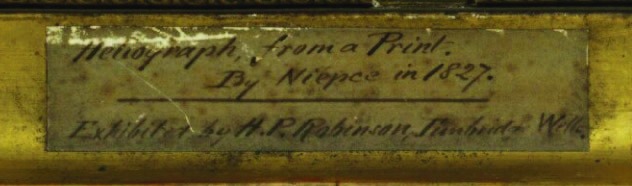
d1 · Heliographic drawing on tin. Image 113×83 mm; plate [198×133] mm. In a gilt frame with a label “Exhibited by H. P. Robinson, Tunbridge Wells”. London, Victoria and Albert Museum.
Provenance. Given by Niépce to Francis Bauer, in 1827; Bauer sale, Christie’s, London, 24 November 1841, lot 187 (£2 10s), bought by Robert Brown; his assistant John J. Bennett, 1858; [his sale, Tunbridge Wells, April 1884]; Henry Peach Robinson, Tunbridge Wells, by whom exhibited; his son Ralph Winwood Robinson, by whom given to the Royal Photographic Society, 1924. Now at the V&A. Literature: Hunt 1844, no. 3.
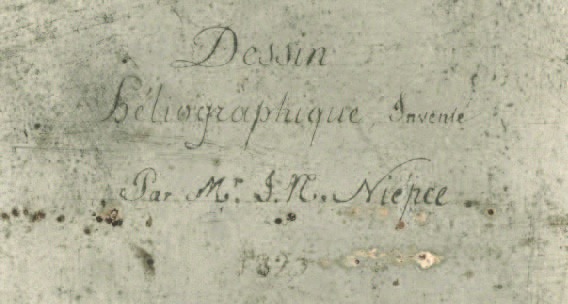
d2 · Heliographic drawing on tin (trace). Plate 161×135 mm; trace of the image about 115×80 mm. Inscribed on the back in Isidore Niépce’s hand: “Dessin héliographique inventé Par Mr J.N. Niépce 182[5, corrected to 3]” (heliographic drawing invented by Mr. J. N. Niépce). Musée Nicéphore Niépce, inv. 1975.149.2.11; formerly Musée Denon.
Provenance. Given by Nicéphore Niépce to M. Gaucher de Champmartin, Isidore’s father-in-law, who was to bring the copper plates and the meniscus prism in June 1825; returned to Isidore at his death; given by Isidore to the museum at the request of Jules Chevrier, 1861.
Source print. Étienne-Frédéric Lignon (1779-1833) after Joseph Albrier (1791-1863), Jésus-Crist (sic), engraving, frontispiece of L’Office de l’Église, en françois, Paris, Dehansy, 1816. Private collection.
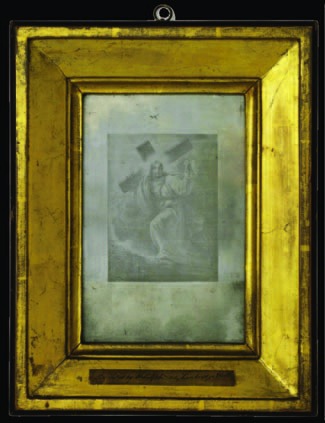
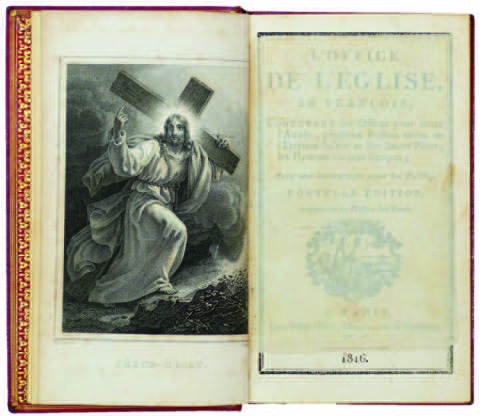
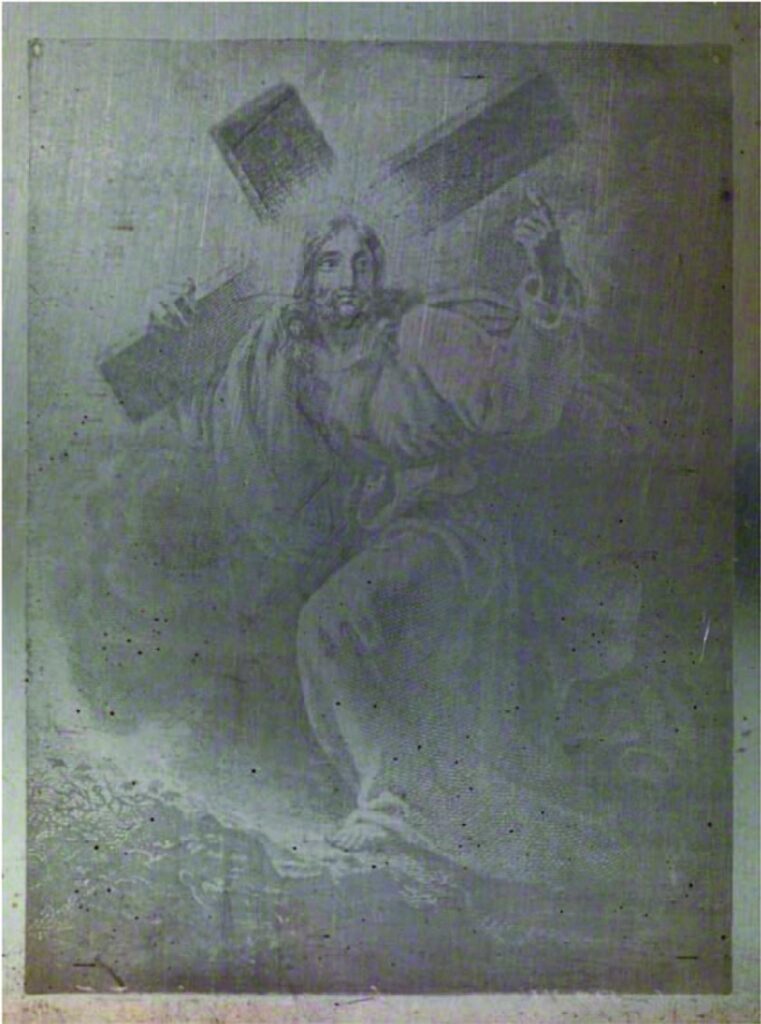

On 28 March 1827 Lemaître sent Niépce eight prints, with their prices. Among them was “Le Christ”, at 1.50 francs: a printer’s proof of the frontispiece of a small prayer book, bought by an inventor who needed a plate, not a prayer.
The copy was made without acid. The idea was not new. On 16 February 1827, answering Lemaître’s criticism of his first plates, Niépce had already written:
Nicéphore à Lemaître, Chalon, 16 février 1827
“[…] cette image qu’on peut regarder comme le beau idéal du lavis, étant toute composée de nuances extrêmement délicates ; cependant mon procédé est susceptible de les retenir, et de les exprimer avec une grande fidélité. Je ne prétend pas dire par là, qu’il soit de même possible d’obtenir ce résultat sur métal, à l’aide des acides ; car le genre de l’aqua-tinta dont je n’ai d’ailleurs qu’une idée très superficielle, me semble présenter de grandes difficultés. Mais, s’il fallait renoncer à l’avantage de multiplier les épreuves par le moyen de la gravure, on aurait du moins celui de se procurer une copie exacte et inaltérable de la nature par ce même procédé.”
“[…] this image, which may be regarded as the ideal of wash drawing, being composed entirely of extremely delicate shades; yet my process can retain them and render them with great fidelity. I do not claim by this that the same result can be obtained on metal with the help of acids, for the manner of aquatint, of which I have besides only a very superficial idea, seems to me to present great difficulties. But if one had to give up the advantage of multiplying prints by means of engraving, one would at least have that of procuring an exact and unalterable copy of nature by this same process.”
Five months later the step was taken. On 24 July 1827 Niépce told Lemaître that Daguerre’s verdict on the Sainte Famille (NN3), “impartiale, à ce que je crois, mais sévère” (impartial, I believe, but severe), which only repeated Lemaître’s own, had slowed his zeal: “Je me suis donc livré à une autre application qui n’exigeât pas l’emploi des acides. J’ai d’abord copié assez heureusement, quelques-unes des gravures que vous avez bien voulu me procurer.” (So I turned to another application, one that would not require the use of acids. I first copied, fairly successfully, a few of the engravings you were kind enough to obtain for me.) The two plates confirm it. The London plate still holds the image in its bitumen, seen by reflection, and Robert Hunt could admire “every line beautifully sharp” in a plate that has no lines in the metal. The Chalon plate, once cleaned, holds nothing but the ghost of its surface. Had Niépce etched it, the lines would have outlived the varnish.
On the London plate the image is the mirror of the print: the varnished sheet was laid face down on the metal, as for a plate meant to be printed. Niépce prepared his Christ as a matrix, then left it unetched, a dessin héliographique (heliographic drawing).
Isidore wrote to Chevrier that the Chalon plate dated from the years 1823 to 1825, and added: “L’inscription tracée par moi sur le métal même, porte la date de 1825” (The inscription I traced on the metal itself bears the date 1825). The label now reads “1823”. Between the letter and the plate, the son had aged his father’s invention by two more years, as he did on the small landscape (NN4). The print did not reach Le Gras before the end of March 1827. This is the third of Isidore’s labels, after NN4 and NN9, that the letters contradict.
Notes. Niépce to Lemaître, 16 February 1827; Lemaître to Niépce, 28 March 1827; Niépce to Lemaître, 24 July 1827 (Bonnet and Marignier 2003, nos 410, 415 and 421). Marignier reads the letter of February as the first sign that Niépce would be content with the image in the bitumen, without acid (no. 410, n. 2), and the letter of July as the announcement of a new application “que nous pressentions depuis février 1827” (which we had foreseen since February 1827) (no. 421, n. 1). Daguerre’s letter on the Sainte Famille is not known.
Isidore Niépce to Jules Chevrier, undated reply to Chevrier’s questionnaire (Bonnet and Marignier 2003, Supplément). Marignier (1999, Annexe 19) gives the date of the gift as about 1864, but the plate already appears in the deposit of 1861.
The same frontispiece appears in a few de luxe copies of Olivier Maillard, Histoire de la Passion de Jésus-Christ (Paris, Crapelet, 1828).
Marignier also records two lost plates of the subject, one in the Laguiche collection and one passed from Charles Chevalier to Arago and the Archives de l’Institut in 1839. They may be no more than mentions of the plates catalogued here, and are not numbered.
NN12 · Le Joueur, d’après Charlet
The Gambler, after Charlet
Summer 1827 (tin plate) · No transparency · No prints
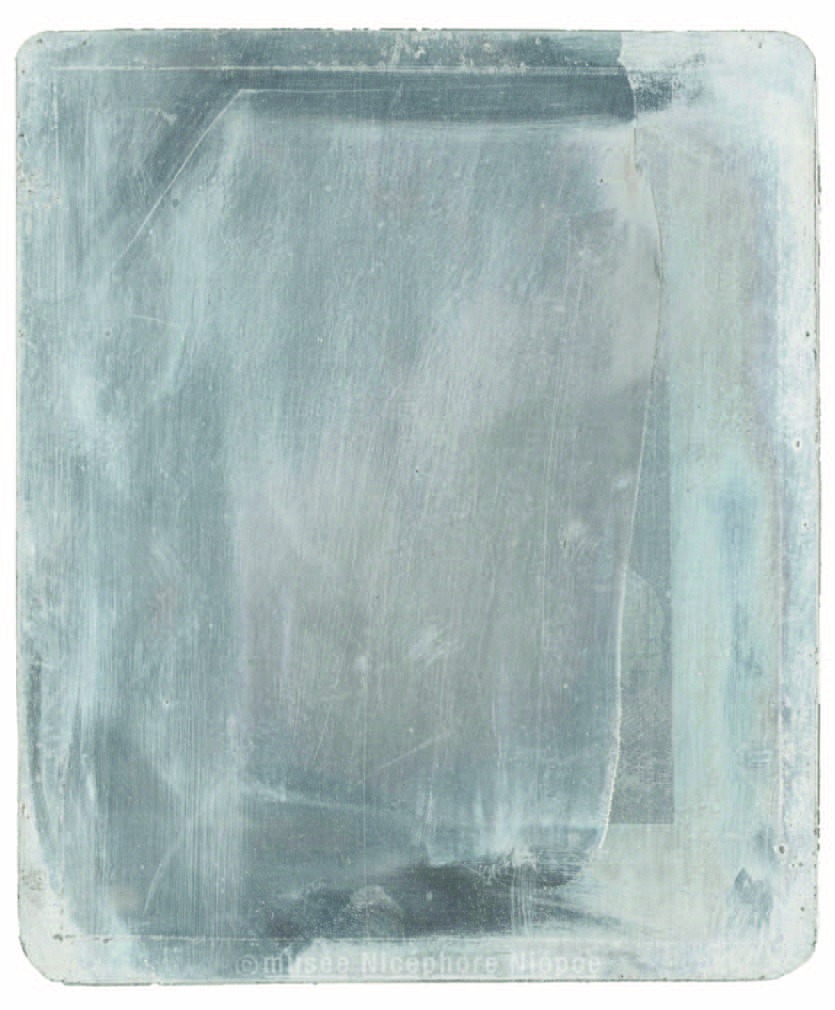
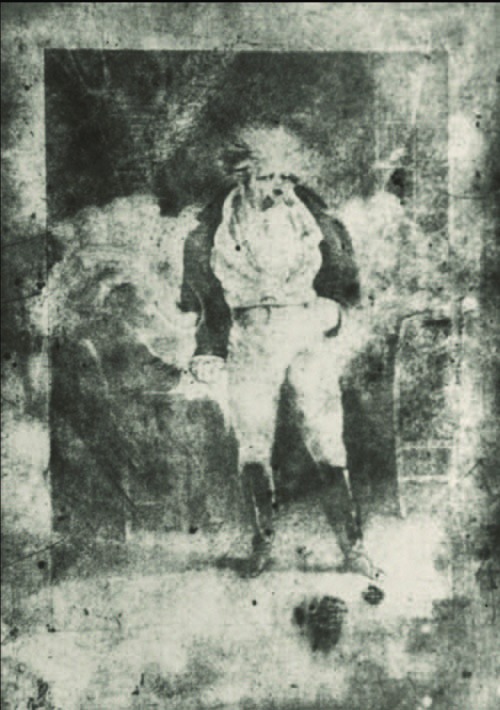
d1 · Plate of tin (95.3 %), bitumen image, no visible etching, the bitumen since partly removed*; image 151×105 mm, plate 205×138 mm. In a frame lined with red felt; on a label on the back: “B.314. / Niépce Nicéphore. no 5, héliographie sur étain. / Image dessinée à l’aide de l’iode. Procédé de 1829. / Date: de 1829 à 1833.” (no. 5, heliograph on tin. Image drawn with the help of iodine. Process of 1829. Date: from 1829 to 1833). Paris, SFP, BnF (B. Lavédrine, P4).
Provenance. Eugène Niépce, grandson of Isidore Niépce, by whom given to the Société française de photographie, 2 May 1890.
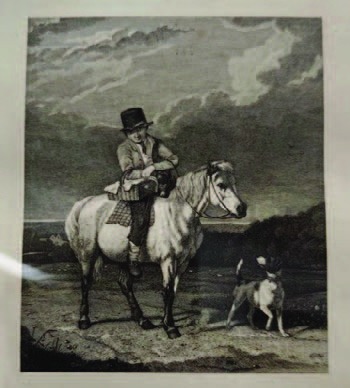
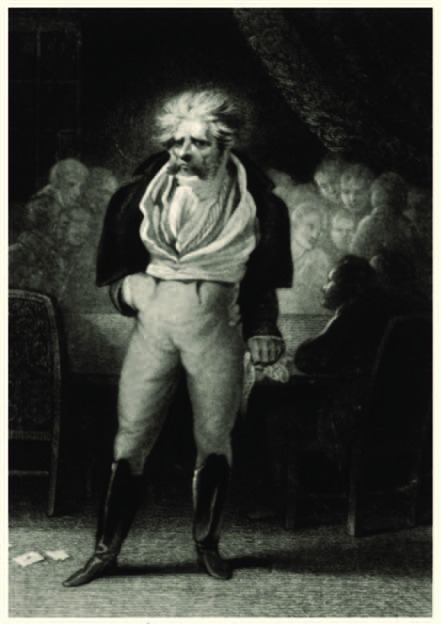
Source print. The engraving itself (t1): George Maile after Nicolas-Toussaint Charlet, Le Joueur, mezzotint, identified by Stephen Bann (2001). An impression, given by André Jammes to Paul Jay for the new Musée Nicéphore Niépce, had long been at Chalon.
On 28 March 1827 Lemaître sent “huit gravures, quatre eau-fortes et burin et quatre aquatinta et manière noire” (eight engravings, four etchings and line engravings and four aquatints and mezzotints). Le Joueur, at 2 francs, was one of the four tonal prints, aquatints and mezzotints, which render shade by flat tones rather than by lines. Niépce copied it onto tin, in bitumen alone, without acid, as he copied the Christ (NN11), before turning his camera to the courtyard (NN14). Light and dark are given only by the bitumen and the bare metal, and the image comes and goes as the plate is tilted.
Few heliographs have been so often redescribed. Eugène Niépce, giving it in 1890, called it “une planche héliographique gravée par son procédé” (a heliographic plate engraved by his process). In 1914 it was found in a box labeled “Planche héliogravure et épreuve d’héliogravure 1824/1826” (heliogravure plate and heliogravure proof), a word Niépce never used, a date he would not have recognized, the plate “pleine de poussière” (full of dust) and having received “aucun soin” (no care). Potonniée remembered framing it himself in 1912; the Société’s inventory has it put under glass in January 1918. A label on the frame then moved it to 1829, “dessinée à l’aide de l’iode” (drawn with the help of iodine): Niépce used iodine to darken silver, which this plate is not. Potonniée called it “l’homme aux cheveux ébouriffés” (the man with tousled hair); Harmant restored the title from Lemaître’s list in 1974. Analysis has since settled the metal: tin, as in 1827. The gambler, at least, kept his cards.
Note. Bulletin de la Société française de photographie, 1890, p. 148. On 15 May 1890 Alfred Davanne thanked Eugène Niépce for “deux épreuves originales de Nicéphore Niepce” (two original proofs by Nicéphore Niépce): the Joueur and a print of the Cardinal (NN6, not numbered). Letter formerly in the collection of Janine Niépce.
Literature. Potonniée 1925, pp. 110 and 160; Harmant 1974, pp. 112-112bis; Bibliothèque nationale, 1967, no. 81; Marignier 1999, p. 578.
* The bitumen is almost gone, yet the gambler remains. Where the hardened bitumen lay, the tin kept its polish; where the solvent had laid the metal bare, the surface dulled, whether from a faint attack during the work or from two centuries of slow tarnish. The image now lies in that difference alone, polished against dull, and appears only when the plate catches the light at the right angle. Lavédrine’s study found it “assez diffus” (rather diffuse), and could not say whether the plate had ever been lightly bitten.
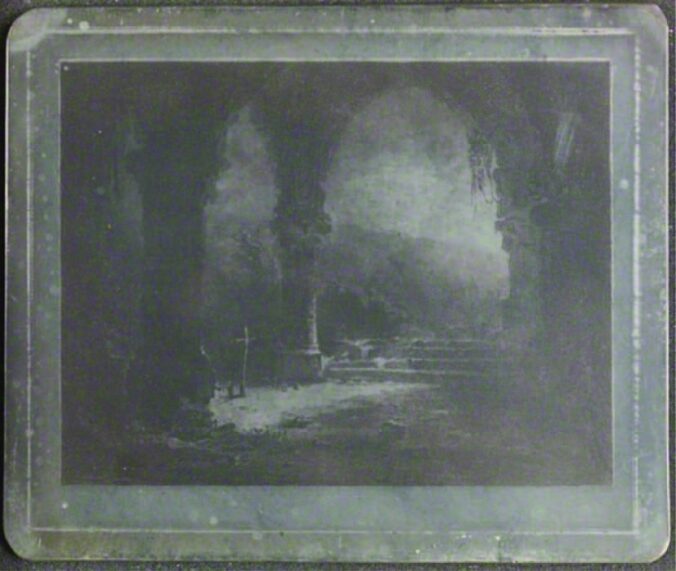
NN13 · Un Clair de lune
Moonlight, after Daguerre (Hunt: “the ruins of an abbey”)
Summer 1827 (tin plate) · No prints
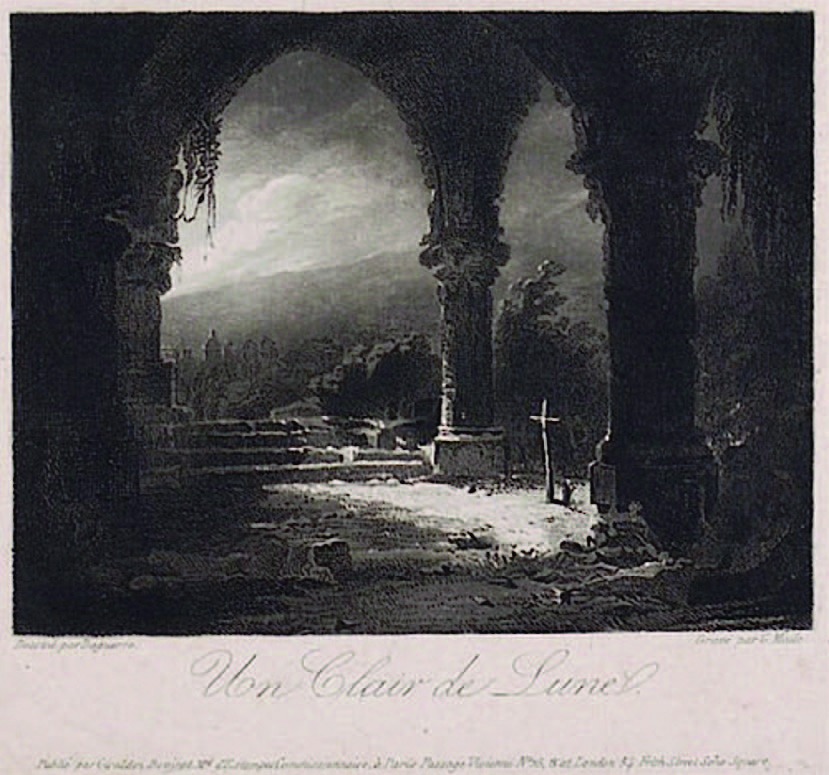
t1 · Mezzotint by George Maile after Louis Daguerre, Un Clair de lune, made translucent with varnish by Niépce, 1827. 103×133 mm. Paris, Cinémathèque française, collection Léon Gaumont.
Provenance. Léon Gaumont; Cinémathèque française.
Source print. The engraving itself (t1). George Maile (1800-1842) after Louis Daguerre (1787-1851), Un Clair de lune, mezzotint, c. 1826. In Lemaître’s list of 28 March 1827, it may be the “Intérieur aqua-tinta” (interior in aquatint), at 2 francs, if the ruin is seen from inside, and if Lemaître, who distinguished “eaux-fortes et burin” from “aquatinta et manière noire”, was vague with his own terms. The lettering, to be confirmed on the original, reads “Dessiné par Daguerre” and “Gravé par G. Maile”, with the address “Publié par Giraldon Bovinet Md d’Estampes Commissionnaire, à Paris Passage Vivienne N° 26, & à London 54 Frith Street Soho Square”: a publisher with a shop in Paris and another in London.
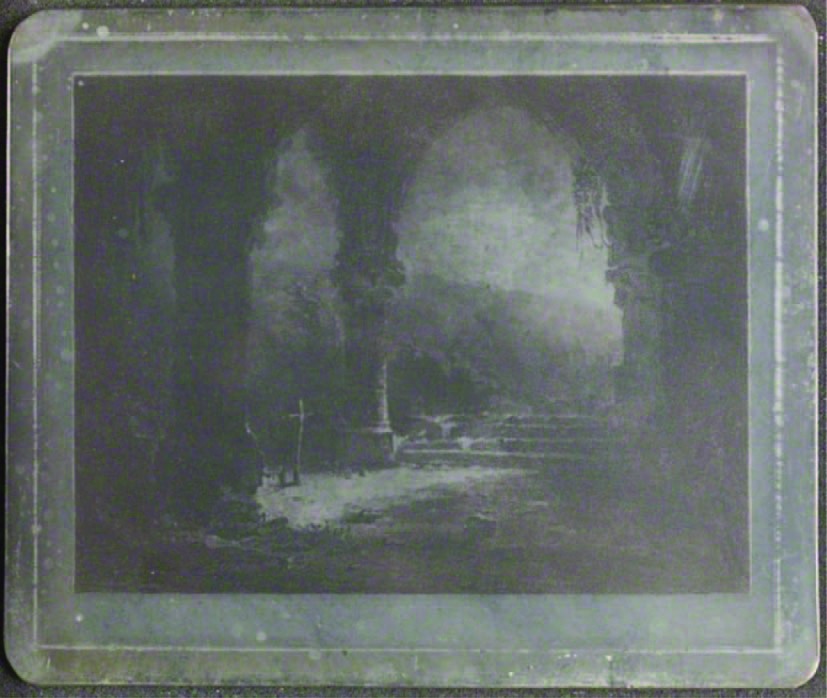
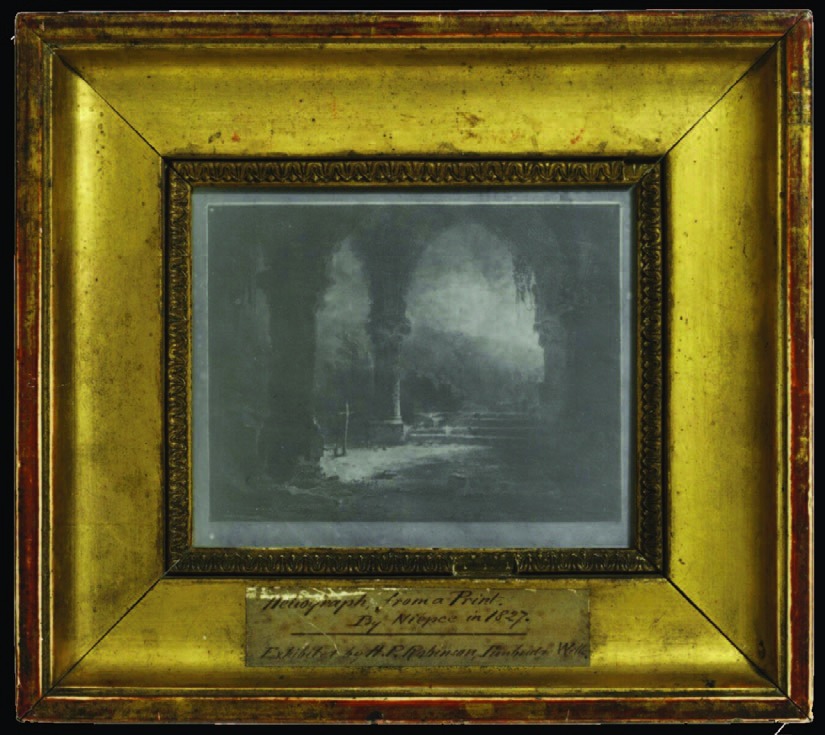
NN13-d1 · Plate of tin, image formed by reflection, no hand tooling; image 101×131 mm, plate 180×140 mm, in a gilt frame 223×252 mm. London, Victoria and Albert Museum, Royal Photographic Society Collection. Hunt 1844, no. 1.
Provenance. Given by Niépce to Francis Bauer, Kew, autumn 1827; [shown to the Graphic Society, London, 20 February 1839]; Bauer sale, Christie’s, London, 24 November 1841, lot 189 or 190, the other being the Cardinal plate of the same size (NN6-m3) (£1 15s), bought by Robert Brown; his assistant John J. Bennett, 1858; [his sale, Tunbridge Wells, April 1884]; Henry Peach Robinson, Tunbridge Wells, by whom exhibited; his son Ralph Winwood Robinson, by whom given to the Royal Photographic Society, 1924; transferred with the RPS Collection to the Victoria and Albert Museum, London, 2017.
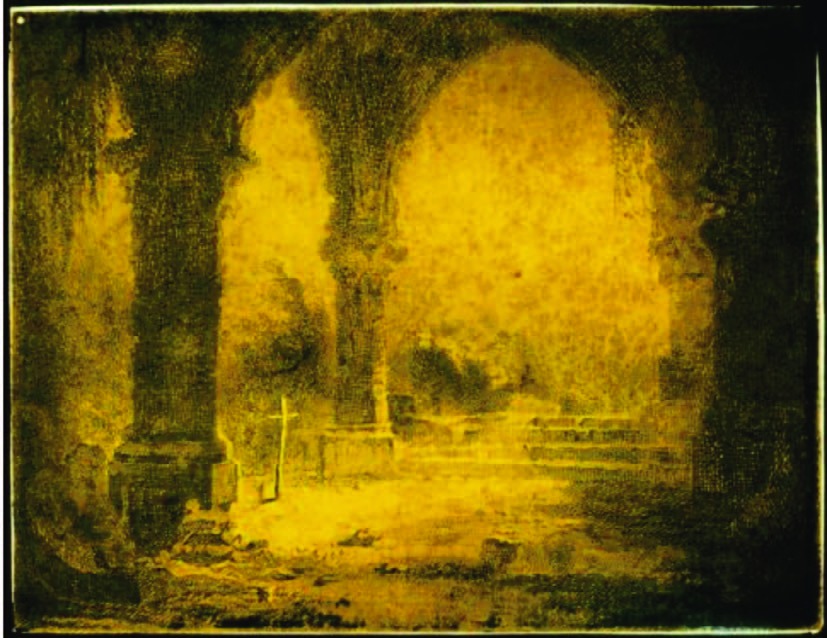
Niépce copied a picture by the man who would take his place. In the spring of 1827 Daguerre had still never seen a single result from Le Gras. He asked for one, and received the Sainte Famille (NN3) in June. Meanwhile, at Le Gras, his moonlight was passing onto tin, by a process he did not know. Hunt, in 1844, saw only “the ruins of an abbey”, “very distinct” when held to a good light. The name of Daguerre was no longer needed to sell a ruin in London, and Niépce’s had not yet been learned.
Hunt found it undamaged, where the view from the window (NN14) was spotted with brown. Its transparency survives too, and traveled further than any other: the sheet that let the light through in France ended in a film collection, among the founders of the cinema; the plate that received it stayed in England. Between the two, the moon has changed sides.
Note. The V&A, which long described the plate as etched, now catalogues it as “a photograph without any hand tooling at all”.
Laisser un commentaire