NN14 · Point de vue du Gras
Nicéphore à Du Bard de Curley, Au Gras, 24 mai 1827
“La campagne est fort belle, mais le temps peu favorable pour la copie des points de vue d’après mes procédés héliographiques. J’en suis donc réduit à épier le bon moment, car mon appareil est prêt à fonctionner. […] Je suis comme Colomb lorsqu’il pressentait la découverte tardive, mais certaine, d’un nouveau monde… Nous avançons, la sonde à la main, sur notre nacelle aventureuse; et bientôt l’équipage s’écriera avec transport… Terre ! Terre !”
“The countryside is very beautiful, but the weather is unfavorable for copying views by my heliographic processes. So I am reduced to watching for the right moment, for my apparatus is ready to work. […] I am like Columbus when he foresaw the late but certain discovery of a new world… We advance, sounding line in hand, in our adventurous little boat; and soon the crew will cry out in rapture… Land! Land!”
Nicéphore à Claude, Au Gras, 27 juin 1827
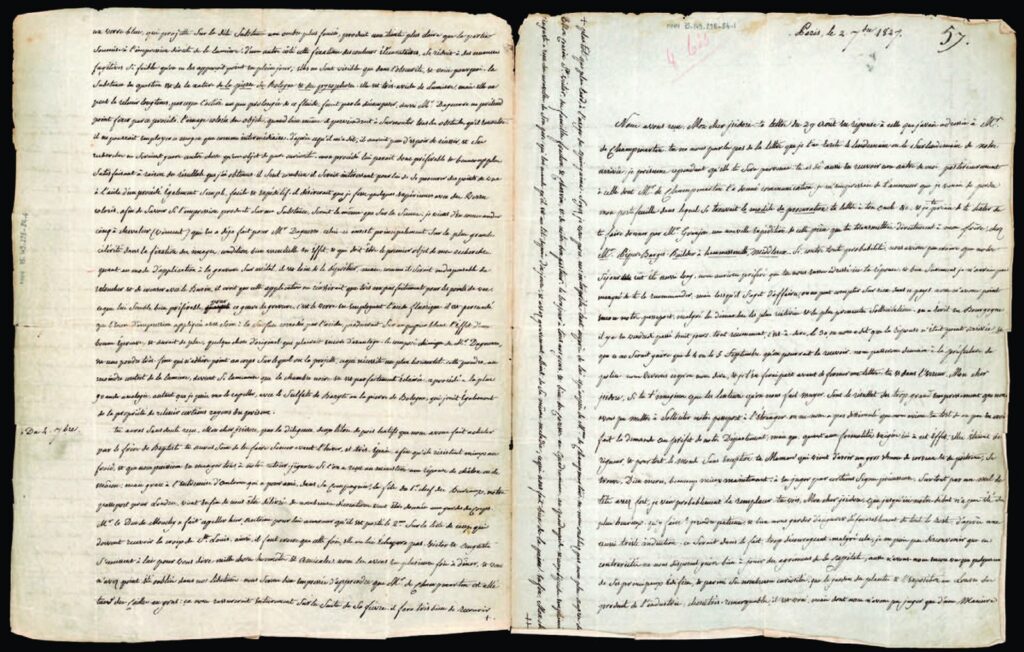
“[…] je me hâte de t’envoyer ci-joint un modèle de procuration, en te priant d’observer qu’il est indispensable que tu m’en fasses passer deux au lieu d’une […], emprunter jusqu’à la concurrence de soixante mille francs. […] J’ai fait un point de vue qui a très bien réussi, sauf un peu de vague que je vais faire en sorte d’éviter; mais ce genre de représentation a quelque chose de magique: on voit réellement que c’est la nature.”
“[…] I hasten to send you herewith a model power of attorney, asking you to note that it is essential that you send me two instead of one […], to borrow up to sixty thousand francs. […] I have made a view that has succeeded very well, except for a slight blur that I shall try to avoid; but this kind of representation has something magical about it: one really sees that it is nature.”
Nicéphore à Claude, Au Gras, 18 juillet 1827
“Tu jugeras que je ne dois guère être en train de travailler; j’ai pourtant fait un second point de vue d’après nature, qui a réussi comme le premier, et dans ce moment même, je m’occupe d’un troisième qui, je pense, n’ira pas moins bien. Mon procédé est excellent, mais les objets ne sont pas rendus dans ma chambre obscure avec une égale netteté.”
“You will judge that I can hardly be in the mood for work; yet I have made a second view from nature, which has succeeded like the first, and at this very moment I am at work on a third which, I think, will go no less well. My process is excellent, but objects are not rendered in my camera obscura with equal sharpness.”
Nicéphore à Lemaître, Chalon, 24 juillet 1827
“J’ai d’abord copié assez heureusement, quelques-unes des gravures que vous avez bien voulu me procurer, et j’en suis maintenant à la copie de points de vues d’après nature, à l’aide de la chambre noire.”*
“I first copied, fairly successfully, a few of the engravings you were kind enough to obtain for me, and I am now at the copying of views from nature, with the help of the camera obscura.”
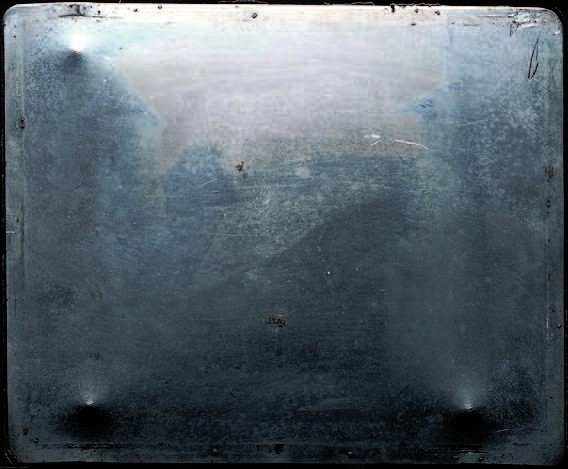
Four letters in two months tell the whole of this chapter. On 27 June 1827, between a power of attorney and a loan of sixty thousand francs, Niépce announced a view from nature “qui a très bien réussi” (which has succeeded very well): “on voit réellement que c’est la nature” (one really sees that it is nature). By 18 July he had made a second, and was at work on a third. On 24 July he told Lemaître that the copies of his prints had come first, and the views after. Of the three views, one survives. It is made exactly as the Christ (NN11) and the Joueur (NN12) were made, an image in bitumen on tin, never etched, seen by reflection; only the model has changed. In place of a print laid on the plate, the courtyard of Le Gras, thrown onto it by a lens.
* Nicéphore à Du Bard de Curley, 24 mai 1827, BnF; Bonnet et Marignier 2003, nos 419, 420, 421.
NN14 · Point de vue du Gras
View from the Window at Le Gras
Summer 1827 (tin plate) · No prints
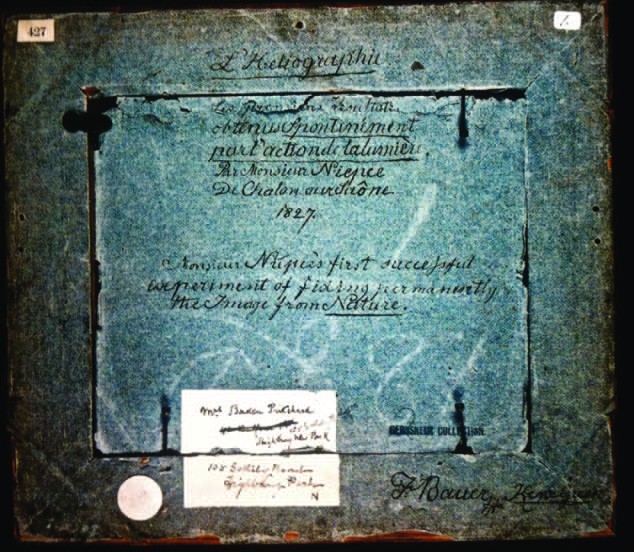
d1 · Plate of nearly pure tin (surface 97.6 % tin, 1.4 % lead, 0.8 % copper, 0.3 % iron: Kaplan et al., Imaging Science Journal, 2013), bitumen image, not etched, a view taken in the camera obscura from an upper window of Le Gras; plate 167×203 mm. On the back of the frame, in Bauer’s hand: “Monsieur Niépce’s first successful experiment of fixing permanently the Image from Nature”. Austin, Harry Ransom Center, The University of Texas at Austin, Gernsheim Collection. Hunt 1844, no. 2.
Provenance. Given by Niépce to Francis Bauer, Kew, autumn 1827; [shown to the Graphic Society, London, 20 February 1839]; Bauer sale, Christie’s, London, 24 November 1841, lot 188 (“Vue”, £2), bought by Robert Brown; his assistant John J. Bennett, 1858; H. B. Pritchard, Tunbridge Wells, April 1884; […]; found by Helmut Gernsheim, 1952; University of Texas at Austin, with the Gernsheim Collection, 1964. On loan to the Musée Nicéphore Niépce, Chalon-sur-Saône, 26 April-20 June 2027.
Hunt, in 1844, described it fairly: “less distinct” than the ruins of the abbey (NN13), the dark masses edged with a whiter border, and the surface “partially covered with minute brown spots”. Bauer had labeled it Niépce’s first success from nature, and that is how the world has known it since. Niépce’s own letters are more modest: he made three views that summer, the first “sauf un peu de vague” (except for a slight blur), and does not say which went to England. The plate that is called the first photograph is certainly one of the first three, and the only one left.
It was made like the copies of source prints during the spring, but with the window of the workroom in place of an engraving, and with an exposure counted, by Marignier’s reconstructions, not in hours but in days. Seen straight on, the plate shows little; tilted to the light, the roofs, the pigeon house, the pear tree and the barn come up out of the tin, as the Christ in London still does.
The plate stayed in England for a hundred and thirty-six years and was lost for half a century of them. In 2027 it returns to Burgundy for eight weeks, for the first time since it left Le Gras.
Note. Niépce to Claude, 27 June and 18 July 1827; Niépce to Lemaître, 24 July 1827 (Bonnet and Marignier 2003, nos 419-421). Bonnet and Marignier date the plate to the summer of 1827 from these letters.
Note. The other views made at Le Gras, from the window of the workroom in 1816 to the views on stone and glass of 1824 (chapter I), the view on copper of 1825 (chapter II), the two other views of the summer of 1827, and the view on silver sent to Daguerre in October 1829, are lost.
Laisser un commentaire