Six claimed Lincoln daguerreotypes, 1968 to 2014
Extract from the monograph The Mystery of the Lost Daguerreotype — Tracing Lincoln’s Image in 1861 (Senigallia, MMXXVI).
False Hopes and True Disappointments
Identification and analysis of old photographs is a patient art; one is often surprised to understand how different one’s neighbor’s vision can be. Six examples follow of collectors or researchers who believed they had found a daguerreotype representing Lincoln. Despite failing to convince others, they persisted — sometimes to the detriment of their health. These cases are valuable, for they prompt us to reflect on the dangers and pitfalls that can arise in reasoning.
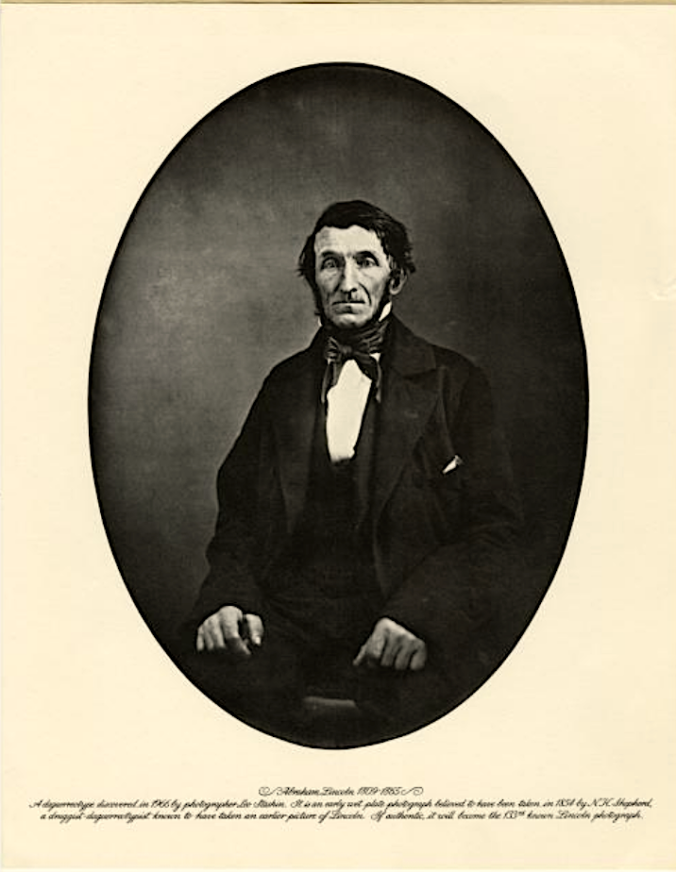
Leo Stashin’s Discovery — 1968
Full-plate daguerreotype, circa 1849
This claim is perhaps the most controversial one can imagine, and the 2024 public might struggle to understand how the 1968 public could attempt to recognise Lincoln in this image.
«Leo Stashin, a photographer, who in recent years turned to collecting and identifying daguerreotypes of 19th-century American statesmen, actors, inventors and businessmen, died Saturday of cancer in St. Luke’s Hospital. He was 54 years old and lived at 75 Bank Street. At his death Mr. Stashin was writing a book on an 1849 daguerreotype he found in a Greenwich Village art shop and which he identified as one of Abraham Lincoln. Lincoln experts disagreed with his identification. This « find » led him, however, to discover and identify other daguerreotypes, including plates of Presidents John Tyler, Zachary Taylor, Millard Fillmore and Franklin Pierce.» (The New York Times, 29 October 1973.)
Harold Holzer, in The Lincoln Visual Image: A Personal Journey of Discovery, recounts:
«In 1968, the New York Times had published a story about this tireless researcher, illustrating it with a daguerreotype he had discovered, which, he insisted, against a tide of criticism, was an early, unknown portrait of Abraham Lincoln. I studied the picture closely: the man seemed too old, too wide around the middle. His nose was too pointy, his brow too narrow, the lips too thin. But Stashin had subjected the imposing full-plate to a barrage of scientific tests and computer scans — such as they were nearly forty years ago — and had identified countless points of similarity, including scars, earlobes, and facial moles.»
Stashin was insistent: «The portrait is the only photograph of Lincoln taken from a high camera angle. This would tend to elongate the nose, foreshorten the brow and change the perspective in which we have been accustomed to seeing his face. The angle makes the nose seem longer.»
Leo Stashin became a friend to young Harold Holzer and transmitted his passion for hunting, chasing, and collecting Lincoln portraits and memorabilia:
«When we got our first apartment on the West Side, we didn’t know what to hang on the walls. A photographer friend, Leo Stashin, invited the young couple on his trips to Pennsylvania Dutch country, in search of daguerreotypes, early photographs. He said, « You should collect Lincoln, and also you can furnish your home that way. »»
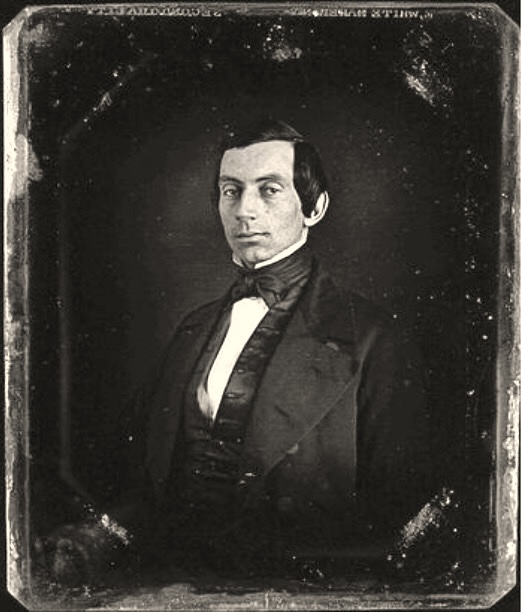
Albert Kaplan Plate — 1987
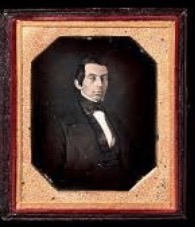
Quarter-plate daguerreotype, circa 1844
The second famous case in recent history is Albert Kaplan’s plate, which gained credibility through the analysis of a plastic surgeon related to a family member.
Claude N. Frechette, M.D., a plastic and reconstructive surgeon, examined the Kaplan daguerreotype:
«In 1987, a photographic print of an exceptionally high quality daguerreotype of a robust, confident-looking, and smartly dressed young man was brought to my office in Paris on, interestingly, Lincoln’s birthday, February 12. The owner of the daguerreotype, which had been purchased from a gallery in New York City in 1977, was Mr. Albert Kaplan, an American then residing in Paris. Mr. Kaplan was convinced, after years of personal research, that the young man pictured in the daguerreotype was Abraham Lincoln. He had sought me out to subject his conviction to the science of my medical specialty… As a plastic and reconstructive surgeon, I examined the Kaplan based on my professional understanding of facial structure and aging. The most objective approach in examining a century-and-a-half old image seemed to be that of a plastic surgeon who evaluates pre- and postoperative photographs and anthropomorphic data of patients with cranio-facial deformities.»
The production area and dating of the daguerreotype were established by an expert:
«In 1980, three years after Kaplan purchased his purported Daguerreotype of Lincoln, one of Kaplan’s experts, Grant B. Romer, a conservator with George Eastman House in Rochester, New York, disassembled and examined the Daguerreotype and declared that it was an « American product made prior to 1845 » and probably an « earlier rather than later 1840s date. » No reason at all to dispute Romer’s findings.» (Joelle Steele, Face to Face: Analysis and Comparison of Facial Features to Authenticate Identities of People in Photographs.)
The persistence of this image in public consciousness, despite ongoing debates about its authenticity, demonstrates the enduring fascination with potential early portraits of Abraham Lincoln.
Hay Wadsworth Plate — 1998
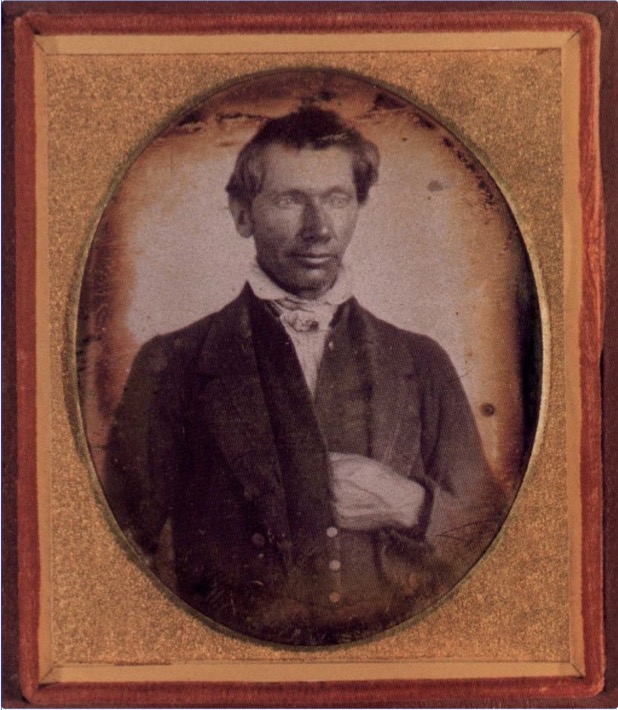
Quarter plate. Portrait of a Gentleman, Believed to be Abraham Lincoln, 1843
The much-debated Hay Wadsworth daguerreotype, dated 1843 and thought by some to be the first image of Abraham Lincoln, was presented by Christie’s. Experts have argued about whether the person photographed is Lincoln ever since the consignors, Robert and Joan Hoffman of Pittsford, N.Y., a suburb of Rochester, unveiled it in 1993. The Hoffmans acquired the three-and-a-half by three-inch leather-encased image from the liquidator for the descendants of Lincoln’s private secretary, John Milton Hay.
To support their contention that the daguerreotype sitter was Lincoln, the Hoffmans and several other believers subjected the image to a range of analyses, from criminal identification techniques to computer « aging » to scrutiny of the vein patterns in the subject’s hand.
Such data convinced Grant Romer, Director of Education at the prestigious International Museum of Photography at the George Eastman House in Rochester, New York. He officially declared, «I recognize the case for the probable cause to believe the subject of the daguerreotype is Abraham Lincoln.» In a recent interview Romer added: «It was the Chicago test that did it for me. I know full well that a lot of people out there see Jesus in their spaghetti, and that image-hungry Americans seem to find ‘Lincolns’ much in the same spirit. But this is a compelling image. It may be hard to reconcile with other poses, but this is a younger man. Of all the ‘Lincolns’ I’ve seen, and I’ve seen plenty, this is the one that has to be seriously looked at. It’s fit to be brought to a wider audience.»
The doubters, including many Lincoln historians and artists, simply pointed out the differences in facial features between the man in the Hoffmans’ image and the earliest documented likeness of Lincoln, now in the Library of Congress. Leading the skeptics was Lloyd Ostendorf of Dayton, Ohio, the co-author of Lincoln in Photographs: «Anyone who buys it will pay a lot of money for a fake.» Ostendorf said the physical features of the man in the picture were vastly different from Lincoln’s, pointing specifically to the ears, nose, shoulders and eyes.
The Hoffmans, who bought the daguerreotype in 1993 for an undisclosed sum, had decided to let the market rule. The daguerreotype failed to sell at Christie’s. The auctioneer started the bidding at $110,000 and, after two bids, stopped at $150,000 — below the estimate of $200,000 to $300,000.
«We’re sorry it didn’t sell,» an obviously disappointed Mr. Hoffman said, adding, «We wanted it to go to the next level of custodians, preferably a public institution.» But he said he still believed the image was Lincoln’s. «This is an ongoing process. We are talking about more research — there’s a tremendous amount of new photo analysis coming available in the next few years.»
The Mississippi Composite Plate
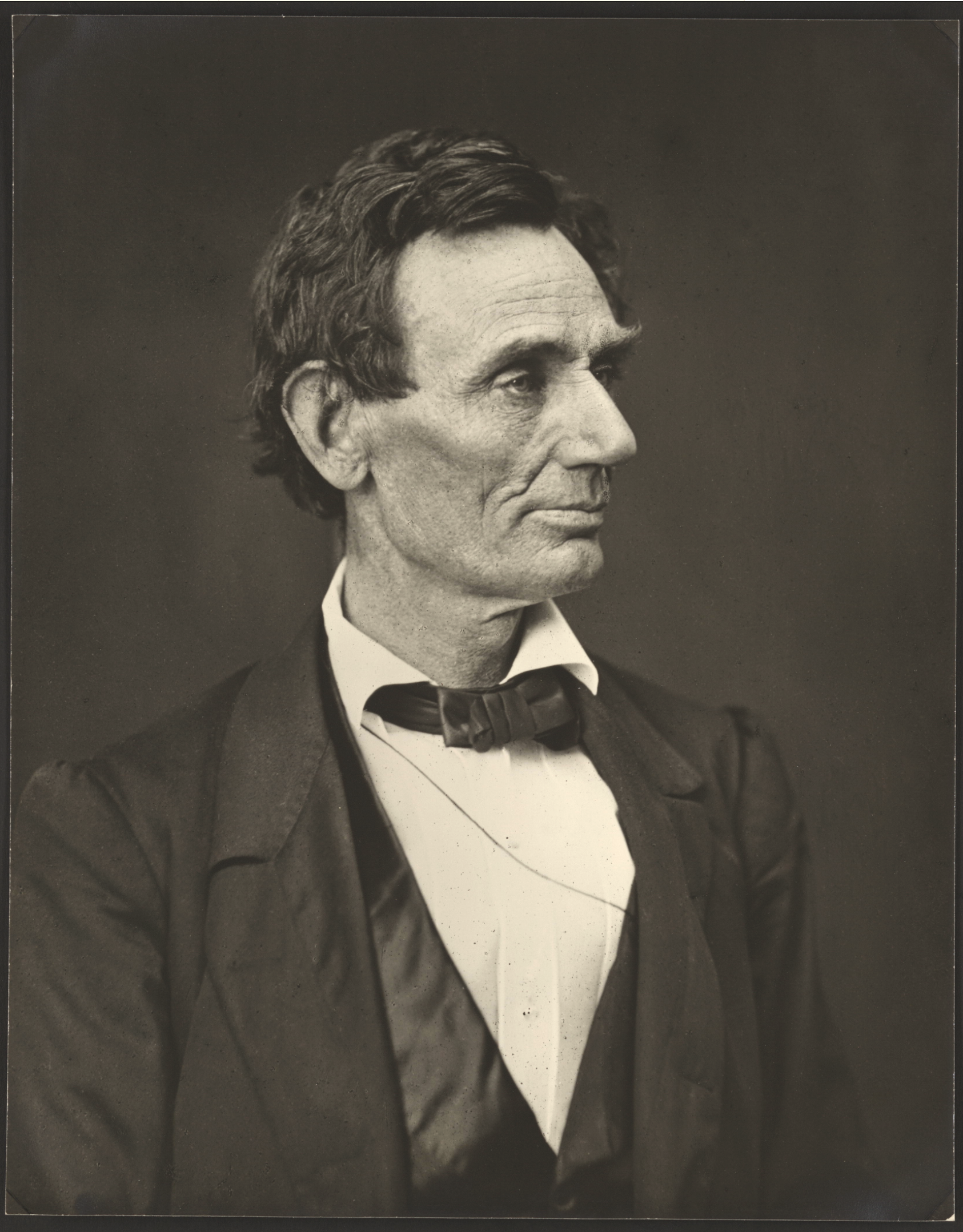

Half-plate daguerreotype, no date
The Mississippi State catalogue entry for this item describes it as a «daguerreotype (possibly a reproduction)» featuring a reversed image of Abraham Lincoln’s bust-length portrait. The original image was captured by Alexander Hesler in Springfield, Illinois on 3 June 1860, and is referenced as O-26.
This entry raises some important points. The uncertainty about whether it’s an original daguerreotype or a reproduction is noteworthy. The image is likely a recent reproduction rather than an original daguerreotype from 1860. This is because in the last 30 years, there has been a revival of interest in original photographic processes, including daguerreotypes. Such reproductions are often created for various reasons — contemporary art, historical reenactments, or occasionally to deceive collectors.
In this case, it’s unlikely to be a deliberate fake, as the nature of the reproduction is apparent. It may have been created as an exercise during a daguerreotype workshop, using a static subject that’s easier to capture with the lengthy daguerreotype process.
The lack of signature or documentation on the piece contributes to its mysterious nature, especially for iconographers unfamiliar with the daguerreotype process. This case highlights the challenges in authenticating historical photographs and the importance of understanding both historical and contemporary photographic techniques when evaluating such items, especially when limited to online reproductions. Access to only digital versions further complicates the authentication process, as important physical characteristics and subtle details may be lost in digital reproduction.
The item is part of the Justice Frank J. and Virginia Williams Collection of Lincolniana.
The eBay-Whiting Plate — 2013
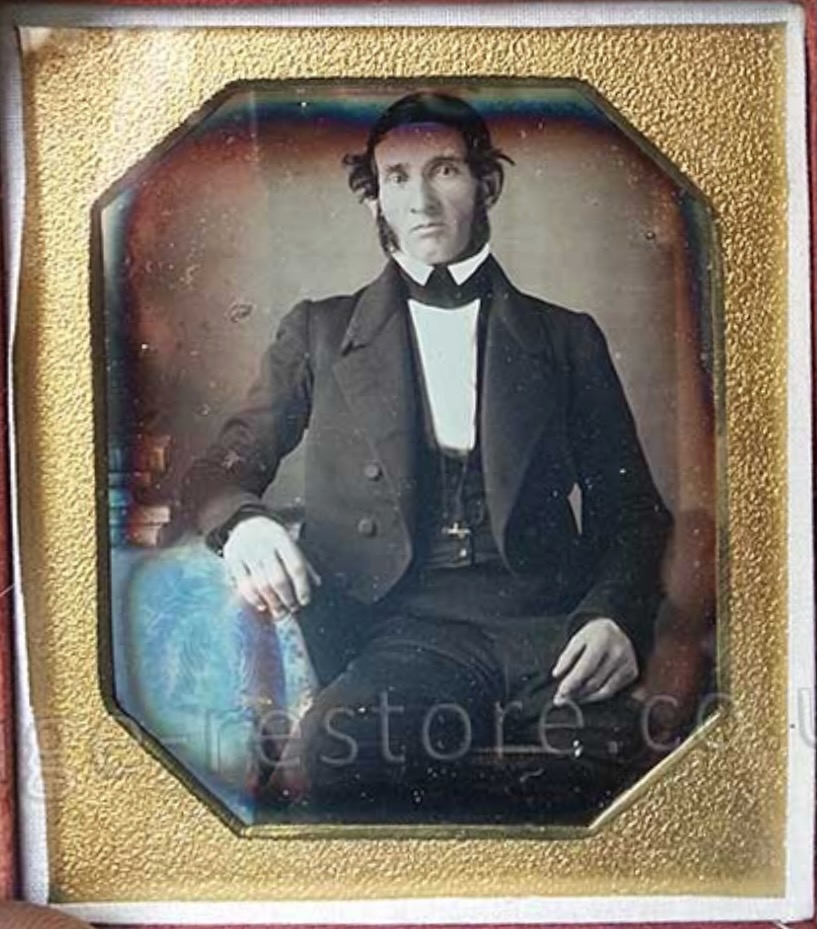
1/6 plate daguerreotype, circa 1850
This case was primarily promoted by a blog article by Neil Rhodes on 11 April 2013:
«A newly discovered Daguerreotype was found by Justin Whiting of Norwich Norfolk, the United Kingdom, could be a new photographic piece in Abraham Lincoln’s historic life story. Purchased on eBay from a power seller of Daguerreotypes, Justin was sure it reminded him of someone. He’d been searching for an image like this for some time. In his mind, it could be no one else other than a young Abraham Lincoln!»
Whiting’s approach to authentication raises several concerns:
«He set about the process verifying the image by asking American museums if they were willing to help identify the man in the image… Justin contacted some museums in America to present his findings. He was expecting some very positive responses. Instead, he was shunned by one museum saying it was not Lincoln and looked nothing like him. They offered no further explanation other than « his hair looks ridiculous ». He soon realised it was not going to be easy, the American museums were very dismissive, with an attitude of, « here we go another picture claiming to be Lincoln, we get loads ».»
Despite expert dismissal, Whiting persisted: «Undeterred, Justin decided to hunt for someone who can offer a more scientific investigation to match the facial features. The scientific road now appears to be the only answer.»
Whiting’s approach, while unconventional, reflects a growing trend of citizen historians leveraging digital platforms to contribute to historical discourse. However, it also underscores the delicate balance between encouraging public engagement with history and maintaining scholarly standards.
Young-Orleman’s Plate — 2014
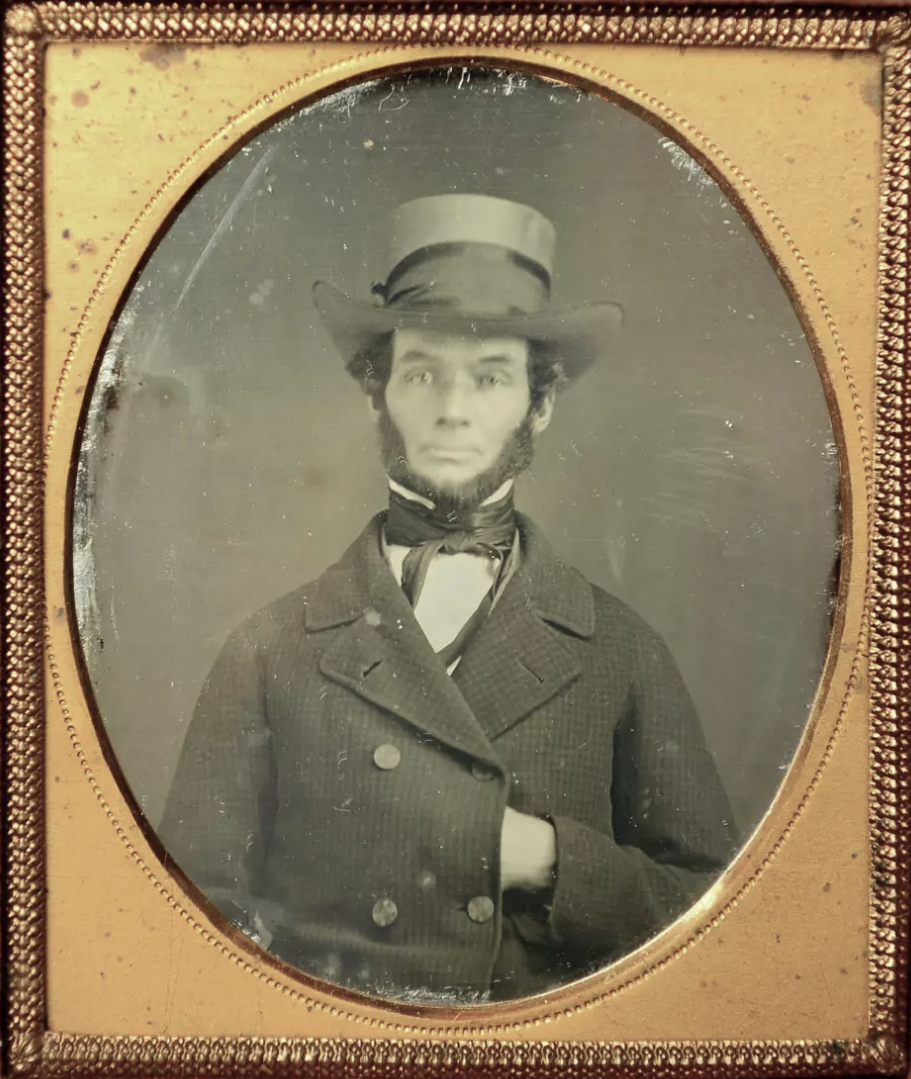
1/6 plate daguerreotype, circa 1849
The complete story as told by Paul Grondahl for the Times Union in April 2014:
«Brisbane Young was at the newspaper office, trying to convince me that he owns an unknown image of young Abraham Lincoln, an 1840s-era daguerreotype he purchased online in 2006 from a woman who said she bought it at a flea market in Virginia. The 47-year-old Belize-born wedding photographer and painting contractor from Queensbury will not say exactly how much he paid for it, but inferred it was a couple hundred bucks. If, indeed, the silver-coated metallic plate turns out to be a well-dressed, bearded, top hat-wearing Lincoln in his early 30s — right hand thrust dramatically in between the buttons of his coat — it would be worth a large sum of money.»
Despite being rejected by Lincoln experts, Young persisted in his quest to authenticate the daguerreotype. Young’s friend, Greg Orleman, supported his claim: «As soon as Brisbane showed it to me, I said that’s Abraham Lincoln.» Young «got lukewarm encouragement from Grant Romer, former director of the George Eastman House’s advanced residency program in photographic conservation in Rochester. Romer wrote in a 2008 letter that Young’s daguerreotype was « very worthy of serious consideration » but that authenticating it was fraught with obstacles. He did not render a final verdict, but urged Young to pursue the forensics analysis route and mentioned a $500,000 estimate of its potential worth.»
However, expert opinions remain skeptical: «There’s no way that looks like Lincoln to me. The lips and many other things are wrong,» said Dennis Holzman, owner of Holzman Antiques of Cohoes. Daniel Weinberg, owner of the Abraham Lincoln Book Shop in Chicago, was more emphatic: «This is a no-brainer. It’s not him. Not even close. I’ve seen much better fakes. It’s just not Lincoln. This guy’s too much of a dandy. The beard is at the wrong time. Lincoln didn’t grow a beard until 1860. The nose isn’t out of joint like Lincoln’s. He doesn’t have that famous lower lip.»
Weinberg added: «I’ve heard so many of these stories over the years. The owners are true believers. They’ll fight to the death trying to prove something that can’t be proven.»
To be continued — Episode 4: « A Discovery at a Manhattan Photo Fair — New York 2017, and the question of Lincoln look-alikes ».
Sources & Notes
- Deschin, Jacob. « Photography: Lincoln’s Portrait In Controversy. » The New York Times, 21 January 1968.
- Holzer, Harold. Interview, 19 September 2018. The Journal News (eu.lohud.com).
- Frechette, Claude N. « The Kaplan Daguerreotype of Abraham Lincoln. » younglincolnportrait.com.
- Steele, Joelle. Face to Face: Analysis and Comparison of Facial Features to Authenticate Identities of People in Photographs. Joelle Steele Enterprises, 2013.
- « Is This The First Photograph Of Abraham Lincoln? » American Heritage.
- Dobrzynski, Judith H. « Would-Be Image of Lincoln Fails to Sell. » The New York Times, 7 October 1998.
- Hamilton, Charles and Lloyd Ostendorf, eds. Lincoln in Photographs: An Album of Every Known Pose. Norman: University of Oklahoma Press, 1963, p. 46.
- « Daguerreotype Image of Abraham Lincoln, 1860. » Frank and Virginia Williams Collection of Lincolniana, Mississippi State University Libraries.
- Rhodes, Neil. « Rare Daguerreotype discovered of young Abraham Lincoln. » Image Restore, 11 April 2013.
- Grondahl, Paul. « Image of young man tests conventional wisdom about Abraham Lincoln. » Times Union, 3 April 2014.
Laisser un commentaire