A catalogue raisonné counts what survives. This one has counted, between 1825 and 1829, some thirty-three objects: transparencies, plates and prints, five of them known only from documents. Niépce’s letters and Isidore’s uncertain memory describe at least as many again that no one has seen since.
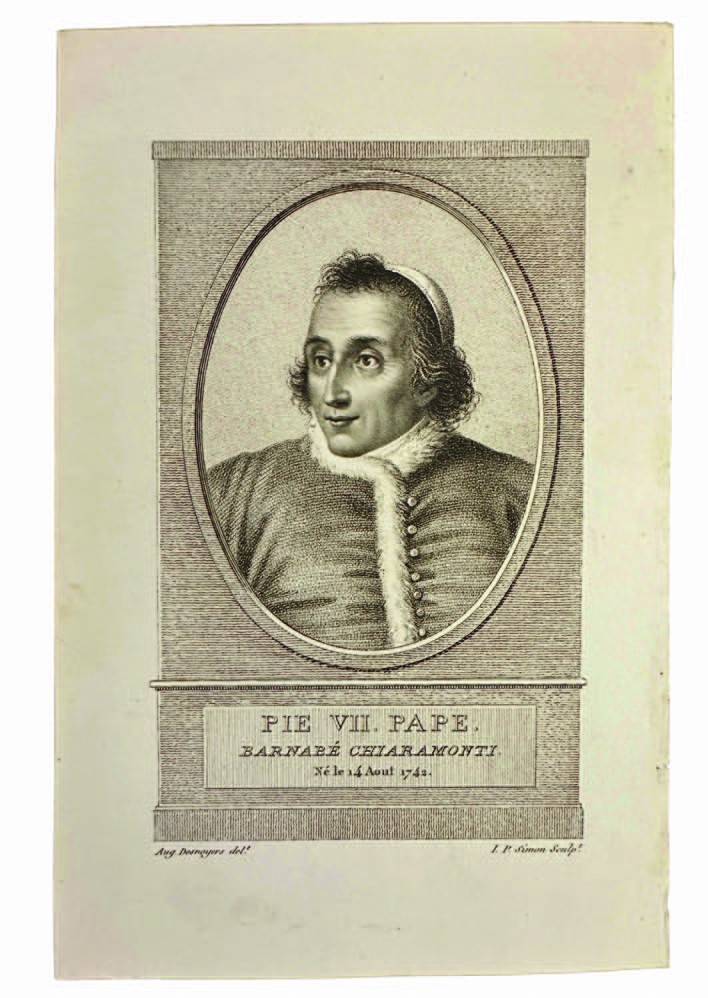
The first is the oldest, and Isidore has rewritten its story. His father, he wrote in 1841, had obtained in bitumen of Judea, on glass, “l’admirable reproduction du portrait du pape Pie VII” (the admirable reproduction of the portrait of Pope Pius VII), and given it to an old relative, General Poncet du Maupas, who had championed the pyréolophore since 1807.
The general had it framed in Paris by Alphonse Giroux, “dans un cadre à deux verres” (in a frame with two panes of glass): the same Giroux who, in 1839, would build and sell Daguerre’s first cameras. Isidore dated it to 1822. The letters tell another story. In July 1822 Claude could only hope that the general “sera également enthousiasmé de la beauté de ta découverte” (will be equally delighted by the beauty of your discovery): he had not yet seen it. In April 1825, Poncet described the process to the mineralogist Gillet de Laumont and asked him for the right mordant; in the same letter he judged Claude’s English machine “impossible”, while the brother who had stayed at home “prétend avoir fait une autre découverte bien singulière” (claims to have made another, quite singular discovery). He died on 5 June 1825. The portrait on glass belongs between the two letters, most probably to 1824.*
Then the views: the window of the workroom, already in 1816, on paper that would not hold its negative image; the views of 1824 on stone and on glass; the view “pris de la chambre où je travaille” (taken from the room where I work), etched with the Horse in August 1825. Of the three views from nature made in the summer of 1827, one went to England and survived. Of the other two, the letters say nothing more. The copper plates of 1825, from which the first prints were pulled in Dijon, are gone; the prints remain, the Horse with Isidore’s letter to his cousin, the Jeune Fille with the colonel’s family. Of Curley’s parcel, the Erasmus failed and was not kept. Two prints of the Cardinal, one given to La Blanchère, one in the museum at Lyon, were last seen in 1890. A Christ passed from Charles Chevalier to Arago, and into the Archives de l’Institut in 1839, if it ever existed apart from the two catalogued here. The view from nature on silver that Niépce sent to Daguerre in October 1829, the first to show what the new metal could do, was shown to Arago in early 1839, and has not been seen since.
Daguerre, meanwhile, lost his own. On 8 March 1839, two months after the announcement of the daguerreotype, the Diorama burned. The officer of the fire brigade remembered, thirty-five years later, Daguerre running up to him: “Pour Dieu ! Monsieur l’officier ! laissez brûler le Diorama, j’en ai fait le sacrifice; mais je vous en conjure […] faites tous vos efforts pour empêcher la flamme d’arriver jusqu’au cinquième étage.” (For God’s sake, officer! Let the Diorama burn, I have given it up; but I beg you […] do everything you can to keep the flames from reaching the fifth floor.)
Whatever Niépce had left with him, the view on silver and perhaps the views of 1827 after the partnership of 1829, may have gone with it, and perhaps the letters that would have told us.
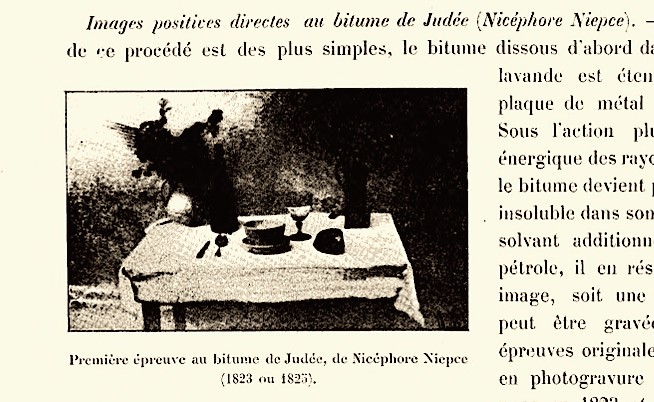
The Table servie, a still life on glass, reached the Société française de photographie in 1891, was shown at the Exposition Universelle of 1900, and then vanished. It was broken in 1909 by a professor seized with madness, or burned, or merely mislaid, or lost on loan to an exhibition: each historian has his version, and none has a document. It survives only in reproduction, a halftone of 1891 and a photogravure made for the exhibition of 1900, and perhaps was never Nicéphore’s: its cast shadows ask for an exposure far too short for bitumen, and it may be one of the reconstructions made in 1853-1855 by another Niépce, Abel Niépce de Saint-Victor, the son of Nicéphore’s first cousin.
In England, the plate of the view near Fréjus that Niépce gave to B. Cussell, his brother’s landlord, was last seen at Brighton in 1862; Bauer’s print of the same view was last shown in London in 1894. And the view of Kew church, which so many writers described, never existed at all, except in the pages and desires of Henry Baden Pritchard.
Some things come back under another name. Among the papers Janine Niépce kept was an engraved copper plate, an old man in a turban. It is not documented before 1912, when Potonniée studied it and had a proof pulled; Jay and Marignier reproduced it, and it was long taken for a heliograph by Niépce, the only one on copper to have survived. It is nothing of the kind.
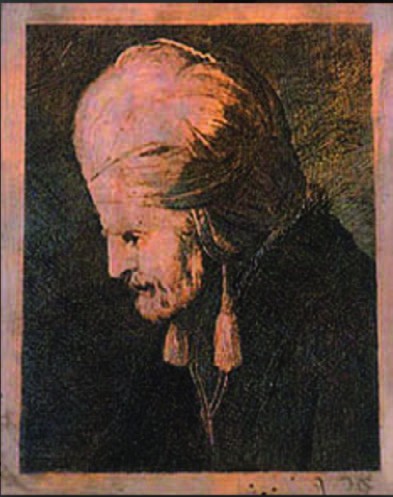
Curley sent it to Le Gras, with a book on engraving, as a model. On 31 January 1827 Niépce thanked him, and found fault: “un défaut plus essentiel par rapport à moi, provient du peu de profondeur de l’empreinte dans la partie supérieure de la tête, partie où la planche n’étant presque qu’effleurée par le mordant, ne pourrait m’offrir un terme de comparaison. Malgré cela, il est à regretter que mon Cousin de Chazan ait renoncé sitôt à un art où il se serait infailliblement distingué.” (a more essential defect, as far as I am concerned, comes from the shallowness of the impression in the upper part of the head, where the plate, barely touched by the mordant, could not offer me a term of comparison. Even so, it is a pity that my cousin de Chazan gave up so soon an art in which he would infallibly have distinguished himself.)
Two days later Nicéphore sent his own plates to Lemaître; a week later Lemaître sent back the same verdict, “trop faiblement” (too faintly). The cousin’s plate had been a term of comparison after all. It is not a heliograph, and it is not numbered here.
What survives, survives for a reason. Almost everything kept was kept as evidence. Bauer, in 1827, framed and labeled what Niépce gave him, and wrote the date on it; when Daguerre’s name filled the newspapers in 1839, he took the plates out to plead for their maker.
Isidore, from 1839 on, wrote on every frame he could find, sometimes the wrong date, always the right name. The family gave what it had to the museum of Chalon in 1861; in 1874 a neighbor of Lux gave what had stayed behind. Eugène gave his to the Société française de photographie in 1890.
The quarrel over priority failed for a century and a half: the name that filled the books was Daguerre’s; but it sent the objects into frames, under glass, with labels, into collections. It lost the argument and saved the evidence. Can we say that what no one needed as evidence was bound to be lost? If the pope, the views of 1824 and the still life went to relatives, or to learned men, or stayed in a drawer, they may still be somewhere. A plate does not burn as easily as a canvas, and the tin at Brighton escaped the melting pot because it was not silver. Others have looked before our time, and found: Gernsheim, who traced the view from the window in 1952 after years of searching; Paul Jay and the Musée Nicéphore Niépce; Manuel Bonnet and Jean-Louis Marignier, who brought the letters together; Isabelle Evrard, who found the prints behind the plates. Their searches went through the family papers, the archives of the Institut and of the Académie, and the trail of Bauer’s effects. What they did not find may yet turn up where no one thought to look.
The engravings Niépce copied for the Jeune Fille, for the Three Figures, for the Mediterranean Figures once taken for Two Greeks and for Frère Luce are still to be found. They were cheap prints, pulled in hundreds, and some of them may have survived.
The plates that reappeared in 1999 had never left Chalon; they had only lost themselves in a museum. One more heliograph may be found.
Notes. The catalogue numbers thirty-three objects for sixteen compositions: twenty-eight that survive (seven transparencies, eight matrices, seven drawings and six prints) and five known only from documents (three matrices and two prints).
The pope: Isidore Niépce, Historique de la découverte improprement nommée daguerréotype, 1841, p. 17; Claude to Niépce, 19 July 1822, and General Poncet to Gillet de Laumont, 13 April 1825, with Gillet’s marginal answer (Bonnet and Marignier 2003, nos 366 and 390).
What was lost: Marignier 1999, Annexe 19; Niépce to Lemaître, 4 October 1829 (Bonnet and Marignier 2003).
The Diorama: “Note sur l’incendie du Diorama en 1839, par l’officier des sapeurs-pompiers qui dirigeait les secours”, Moniteur de la photographie, 15 October 1874.
The Table servie: Davanne, Bucquet and Vidal, Musée rétrospectif de la classe 12. Photographie… à l’Exposition universelle internationale de 1900, Saint-Cloud, [1900], pl. “Première épreuve au bitume de Judée, de Nicéphore Niepce (1823 ou 1825)”, page 10; Bernard Lefebvre, A. Niepce de Saint-Victor et « La table servie », Rouen, 1984; Helmut Gernsheim, “La première photographie au monde”, Études photographiques, no. 3, November 1997, notes 17-18.
Kew church: H. Baden Pritchard, About Photography and Photographers, 1883.
The old man in a turban: Niépce to Alexandre du Bard de Curley, 31 January 1827 (BnF, dossier Du Bard de Curley); Lemaître to Niépce, 7 February 1827 (Bonnet and Marignier 2003). What survives: Isidore Niépce to Jules Chevrier, undated (Bonnet and Marignier 2003, Suppl.).
Finito di stampare il 2 novembre 2026 sui torchi della Tipografia Adriatica, Senigallia.
Two hundred years to the day after Niépce wrote to his cousin that the Cardinal had given him “des épreuves plus fortes de ton que toutes celles que j’avais obtenues précédemment” (proofs stronger in tone than any I had obtained before).
Limited edition of 200 copies: 100 numbered and signed copies in English, and 100 copies in Italian
Laisser un commentaire