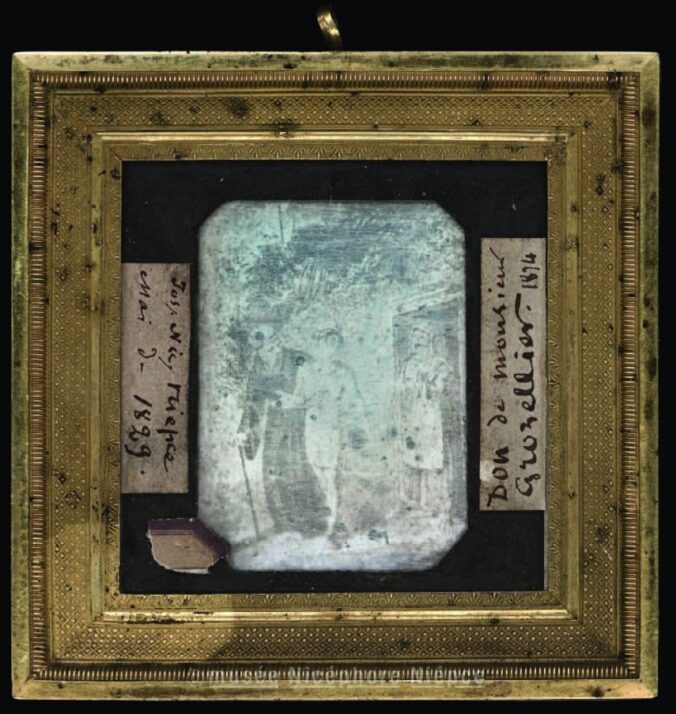
NN15 · Trois Figures en costumes méditerranéens · NN16 · L’Ermite, ou frère Luce
At Kew, on 31 October 1827, Niépce had already named the remedy for his tin: “Mes épreuves encadrées faites sur étain paraîtront sans doute trop faibles de ton […]. On remédierait à cette défectuosité en recevant l’image des objets sur de l’argent plaqué, bien poli.” (My framed proofs made on tin will no doubt seem too weak in tone […]. This defect would be remedied by receiving the image of objects on silver plate, well polished.)
Back at Chalon, he ordered the plates. Four came from Chevalier on 20 June 1828, went back to Paris to be flattened and polished, and returned on 2 July; on 10 July he declared himself satisfied.
In the plan of the book he never wrote, each metal has its use: “Gravure sur cuivre. Dessin sur argent plaqué.” (Etching on copper. Drawing on silver plate.)
The next plate NN15 follows the plan. Lavédrine found no etching; the image lies on the surface of the silver, a picture to be looked at, like the view from the window (NN14). How its dark parts were obtained is not settled. They may be the bare silver itself, dark by reflection, as on the tin plates of 1827; or Niépce may already have reversed the image with iodine, which darkens the bare silver, as he did from the summer of 1829. The substance has not been identified, and the plate keeps its secret.
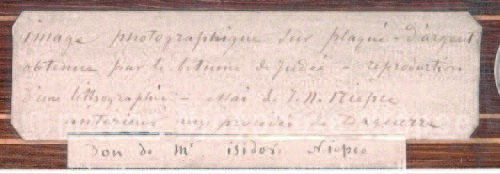
Either way, silver, a positive image and, perhaps, iodine: everything here but the camera and the mercury is already the daguerreotype. The label on the frame says so in its own words, “antérieur aux procédés de Daguerre” (earlier than Daguerre’s processes). Isidore wrote it as evidence for the defense.
Iodine appears in Niépce’s papers only in 1829: in the plan of the book he never wrote, then as no. 20 in the code he agreed with Daguerre. In January 1832 he wrote to his partner that he now used it only “comme terme de comparaison” (as a term of comparison). Daguerre kept to it, and in August 1835, two years after Niépce’s death, announced to Isidore that on iodized silver he had “rétabli les clairs dans leur véritable nature” (restored the lights to their true nature). The daguerreotype was there.*
* Bonnet and Marignier 2003, nos 494, 513, 539 and 576.
NN15 · Trois Figures en costumes méditerranéens
Three Figures in Mediterranean Dress
1828-1829 (silver-plated copper) · No transparency · No prints
d1 · Plate of copper plated with silver, not etched, the image lying on the surface, the substance forming it not identified; image about 92×69 mm, plate 101×152 mm; on the back, a small star lightly engraved, lower center. In an old wooden frame, 191×241 mm, with labels in the hand of Isidore Niépce: “image photographique sur plaqué-d’argent / obtenue par le bitume de Judée – reproduction / d’une lithographie – essai de J. N. Niepce / antérieur aux procédés de Daguerre” (photographic image on silver plate, obtained with bitumen of Judea, reproduction of a lithograph, trial by J. N. Niépce, earlier than Daguerre’s processes); “Don de Mr Isidore Niepce” (gift of Mr. Isidore Niépce); a round label of the Société d’histoire et d’archéologie de Chalon-sur-Saône, no. “159” [or “169”]; a rectangular label, “3”. Musée Nicéphore Niépce, inv. 1975.149.2.10 (B. Lavédrine, P7).
Provenance. Isidore Niépce; gift of Isidore Niépce to the Musée de Chalon-sur-Saône, 1861; missing c. 1976-1999, at the Société d’histoire et d’archéologie de Chalon-sur-Saône, within the Musée Vivant Denon; found again in 1999 (Marignier); Musée Nicéphore Niépce, July 2000.
Source print. A lithograph, according to the label and Meulien (1885); not identified. Studied by Isabelle Evrard in 2005.
Literature. Meulien 1885, p. 293, no. 3; Potonniée 1925, p. 157, no. 2; Armand-Calliat 1950, no. 980; Bibliothèque nationale 1967, no. 79; Marignier 1999, p. 579.
The plate has been long called Un Grec et une Grecque, or Un Couple grec. The title has outlived its evidence. There are three figures, not two, and nothing makes them Greek; Manuel Bonnet saw in them Italian peasants or brigands, of the kind painters brought back from Rome in the 1820s. Potonniée found the plate in 1925 “en très mauvais état, à peu près invisible” (in very poor condition, almost invisible); in 1967 the Bibliothèque nationale noted its strong “miroitage” (mirroring). Silver, which was to make the image clearer, has made it harder to see.
Note. Niépce to Aiton, 31 October 1827; Chevalier to Niépce, 20 June and 2 July 1828; Niépce to Chevalier, 10 July 1828; plan of the book, [1829] (Bonnet and Marignier 2003, nos 434, 472-474 and 494).
Note. Jules Chevrier’s brochure about the Isidore Niépce deposit of 1861 lists a single silver-plated plate. The Ermite (NN16) came to the museum in 1874; the plate of the 1861 deposit must be this one.
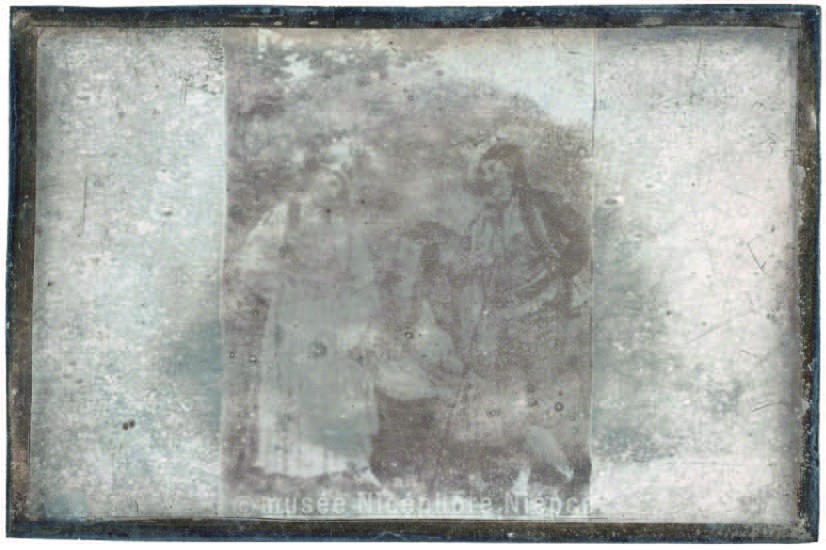
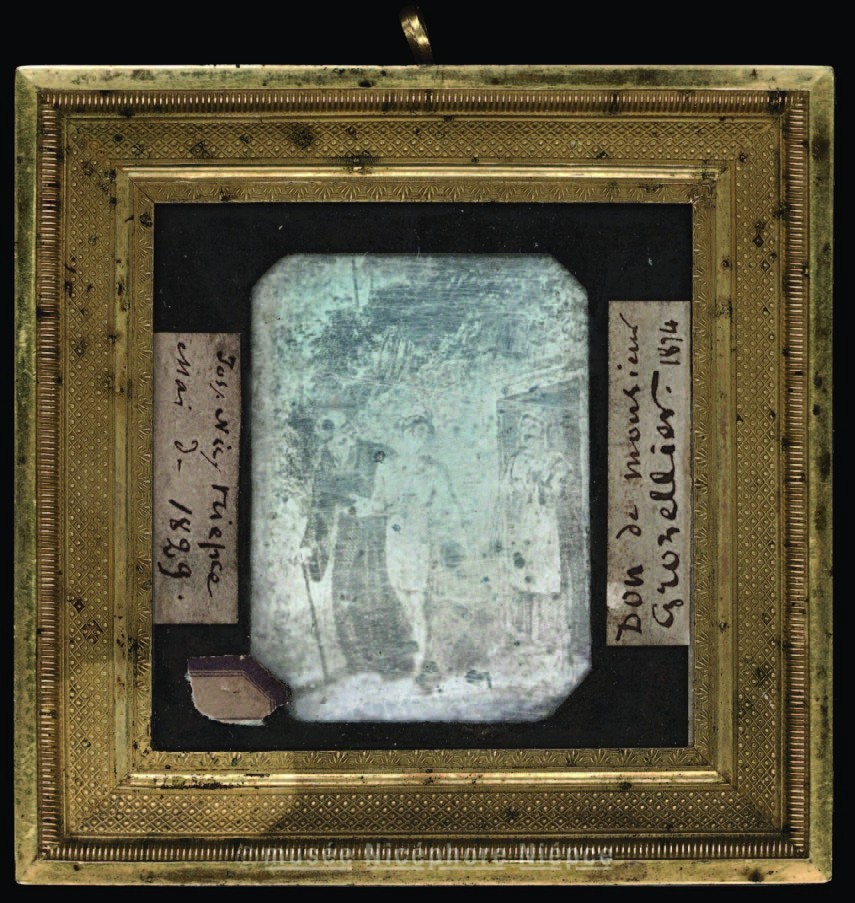
NN16 · L’Ermite, ou frère Luce
The Hermit (traditionally Un moine accompagne un jeune homme, A Monk Accompanies a Young Man)
May* 1829 (silver-plated copper) · No transparency · No prints
d1 · Silver-plated copper, not etched; image 58×45 mm, plate 82×68 mm. Not included in the analyses of 2005-2008. In an old mount, with labels on the glass: “Jos/. Nic/. Niepce / essai de 1829.”; “Don de monsieur / Grozellier. 1874” (trial of 1829; gift of Mr. Grozellier, 1874); a rectangular label, “2”. On the back of the mount: “de Jos. Nicephore-Niepce / essai photographique / sur plaque de Cuivre-Argenté / d’après le témoignage de Mr. Isidore Niepce + de Mde Niepce / Champmartin cet essai a été / fait en l’année 1829 voir aux armoires l’attestation de Mde Ve Niepce” (by Jos. Nicéphore Niépce, photographic trial on silvered copper plate; according to the testimony of Mr. Isidore Niépce and of Mrs. Niépce Champmartin, this trial was made in the year 1829; see in the cabinets the attestation of the widow Niépce). Musée Nicéphore Niépce, inv. 1975.149.2.9.
Provenance. Isidore and Eugénie Niépce, Lux; M. Grozellier, “propriétaire à Lux” (landowner at Lux), by whom given to the Musée de Chalon-sur-Saône, 1874; Musée Nicéphore Niépce.
Source print. The subject is La Fontaine’s tale L’Ermite, “nouvelle tirée de Boccace” (a tale taken from Boccaccio), though its plot comes from the fourteenth of the Cent Nouvelles nouvelles. The same composition, the hermit on the left, the girl in the middle and the mother on the right before a house inscribed “Frère Luce”, appears on two cast-iron firebacks, the plates that line the back of a hearth, one of them dated 1828. Identified by Nicolas Devigne, historian of photography.**
For a century the plate was described as “un moine accompagne un jeune homme” (a monk accompanies a young man). The firebacks show what the silver no longer does: the young man is a girl, and the house is the hermit’s. In La Fontaine’s tale, Frère Luce persuades a mother, by a voice from heaven, that her daughter is to bear a pope, and that he must be the father; the mother gives up her daughter, who in due time bears a girl. The plate shows the moment of the handing over.
The tale was popular enough to be cast for hearths; one fireback bears the date 1828, the year Niépce turned to silver. He did not copy the fireback, and the founders did not copy him: both worked from a print that has not yet been found. A silver plate cannot be earlier than the summer of 1828, and the label, with the testimony of Isidore and his wife, gives 1829.
A tale of a promised birth that came to nothing ends this catalogue of first attempts. It is perhaps fitting.
* The month is given by Marignier, “mai 1829 selon Isidore Niépce et sa femme” (May 1829 according to Isidore Niépce and his wife) (1999, Annexe 19), probably from the attestation of Isidore’s widow to which the label refers.
** Presented by Nicolas Devigne in “Feu, image, femme. Les dames de fonte: représentations du féminin sur les plaques de cheminée”, study day Genre et territoire, Maison Louise de Bettignies, Saint-Amand-les-Eaux, 13 June 2026, in homage to the bicentenary of photography.
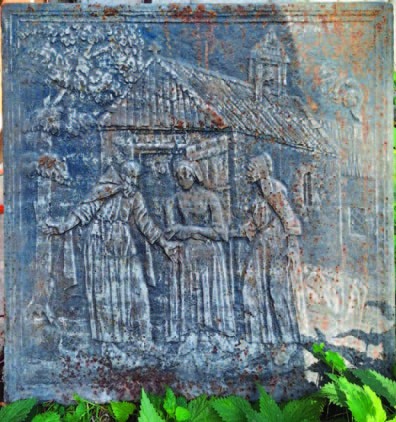
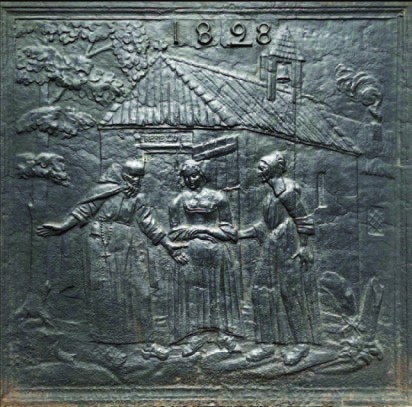
Two cast-iron firebacks with the same composition, one dated 1828: not Niépce’s source, but its cousins (left, collection Nicolas Devigne; right, Marc Maison)
Laisser un commentaire