The First Images Shown to the World
NN1 · Cheval avec son conducteur · NN2 · Jeune Fille à la quenouille
The autumn before, the stone had failed under the acid. From London, Claude urged copper; in April, General Poncet du Maupas asked a friend at the Institut how to bite it; and Niépce gave it, he wrote, the last three months of light the year allowed for views.
On 5 June 1825 he told Curley that he was waiting for his copper plates, and that he would give up “la copie des Gravures” (the copying of engravings) until the winter, to work “exclusivement à la gravure des points de vue” (exclusively on etching views)*.
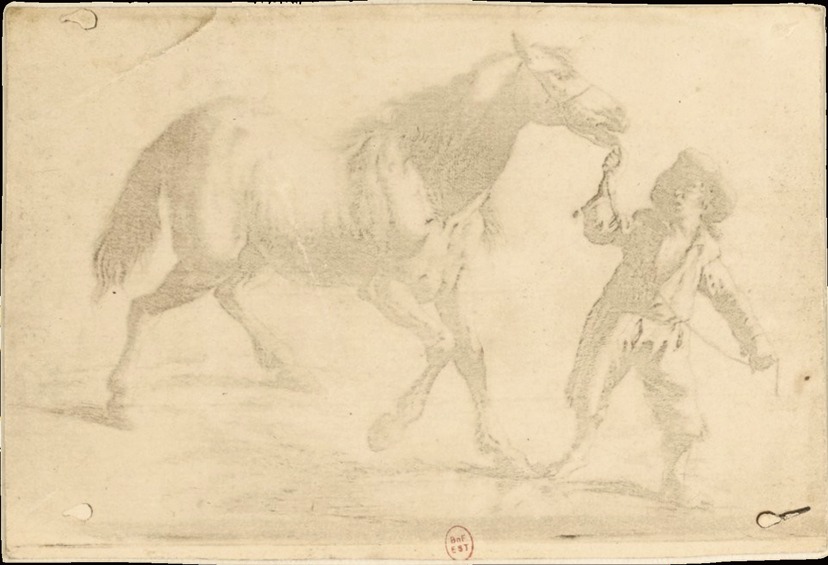
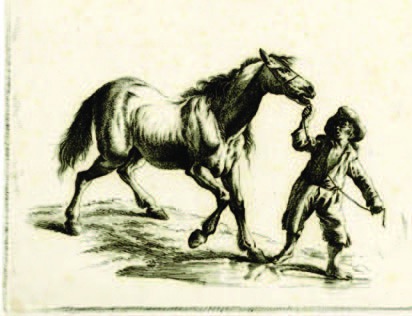
By 7 August he was etching two copper plates, a view from his workroom and, despite himself, a copy: a horse with its leader. He had found how to make a plate deep enough to print: let the light “paint” the image in the varnish, let the acid bite a little into the bare lines, then paint and bite again, “peindre et graver tour à tour” (paint and etch in turn), until the lines could hold the ink: “La préférence marquée que tu parais donner à l’application sur cuivre, de mon procédé, m’a déterminé à m’en occuper exclusivement pendant les 3 mois qui me restent encore pour prendre des points de vue […]. Je grave sur cuivre dans ce moment un cheval avec son conducteur, et un point de vue pris de la chambre où je travaille. Il m’a fallu m’y prendre différemment pour l’emploi de l’eau forte à laquelle j’ajoute une quantité d’eau telle que le métal se trouve oxidé sans être dissout**. Il est faiblement attaqué; mais le vernis est bien ménagé, ce qui est une chose très essentielle. Je puis de cette manière répéter l’opération, c’est à dire, peindre et graver tour à tour, jusqu’à ce que j’aie obtenu le creux suffisant pour l’encre d’impression. Tu juges par là, mon cher ami, que mon procédé a sous ce rapport, un avantage que n’offre pas la gravure ordinaire. […] Pour le cheval de même que pour le point de vue, tout jusqu’ici s’opère comme je l’imaginais. L’action de l’acide suit la dégradation des teintes, et le métal est attaqué peu à peu sans que le champ de l’image se trouve endommagé ainsi que ça m’arrivait lorsque je me servais d’un acide plus concentré. Une chose à remarquer, quant aux points de vue, c’est que le premier résultat ne présente que l’ensemble des objets; et que les détails les plus délicats se peignent ensuite, et se gravent successivement.”***
“The marked preference you seem to give to the application of my process on copper has decided me to devote myself to it exclusively during the 3 months still left to me for taking views […]. I am at this moment etching on copper a horse with its leader, and a view taken from the room where I work. I had to go about it differently in using the acid, to which I add so much water that the metal is oxidized without being dissolved. It is only faintly attacked; but the varnish is well spared, which is a very essential thing. In this way I can repeat the operation, that is, paint and etch in turn, until I have obtained a depth sufficient for the printing ink. You can judge from this, my dear friend, that in this respect my process has an advantage that ordinary engraving does not offer. […] For the horse as for the view, everything so far goes as I imagined it. The action of the acid follows the gradation of the tones, and the metal is attacked little by little without the field of the image being damaged, as used to happen when I used a more concentrated acid. One thing to note, as regards views, is that the first result shows only the general mass of the objects; and that the most delicate details paint themselves afterward, and are etched one after another.”
This was the change that mattered. A view on stone or on glass existed once, in one place, and had to be tilted to the light to be seen at all. A copper plate could be inked, and its image pulled as many times as the paper allowed, and sent where the plate could not go. On 25 October Niépce announced to his cousin that he would have “deux ou trois copies de gravures” (two or three copies of engravings) printed.
Two of these images survive, in three prints; the plates are lost. Within three months the Jeune Fille had traveled to Paris in a colonel’s luggage, and the Cheval to Nuits in an envelope of price lists. Niépce had wanted a process to copy the world. In 1825 he found one that could show it: an image that could be printed, carried and shown to the world.
The world, for now, started with a colonel, two opticians, an old count and a rich cousin at Nuits-Saint-Georges.
* Niépce to Du Bard de Curley, 5 June 1825, Bibliothèque nationale de France (archivesniepce.com)
** In April 1825 General Poncet wrote on his cousin’s behalf to Gillet de Laumont, of the Institut: Nicéphore “n’entend rien aux procédés des graveurs, il ne connoit pas même bien le mordant qu’on employe pour les planches a l’eau forte” (knows nothing of engravers’ methods, he does not even know well the mordant used for etched plates). Gillet drafted his answer in the margin: “De l’acide nitrique etendue d’eau assez pour mordre le cuivre doucement” (Nitric acid diluted with enough water to bite the copper gently). By August, Nicéphore was adding water.
*** Niépce to Claude, 7 August 1825, Saint Petersburg, Archive of the Russian Academy of Sciences (Bonnet and Marignier 2003, no. 392).
NN1 · Cheval avec son conducteur
A Horse with Its Leader
August 1825 (copper plate, lost) · November-December 1825 (print on paper)
[m1] Copper plate, the image formed by light in a ground of bitumen of Judea, then etched with acid, August 1825. Lost, together with the source print Niépce made translucent.
p1 · Print on paper, trimmed to the plate mark, 100×147 mm. Printed in Dijon, certainly by Berthaux-Durand, November-December 1825. On the verso: “Reçu en 1825” (Received in 1825). Paris, Bibliothèque nationale de France, Département des Estampes et de la photographie, Réserve boîte fol. Z-14 (22, A), kept with Isidore’s covering letter.
Provenance. Sent by Isidore Niépce to his cousin Alexandre du Bard de Curley, at Nuits-Saint-Georges, on 12 March 1826, folded in his letter; thereafter with the letters to Curley: Henri de Régnier; the Vieux Marché, Brussels; described by Tristan Schwilden, bookseller in Brussels; collection Marie-Thérèse and André Jammes; their sale, Sotheby’s, Paris, 21 March 2002, lot [ ]; pre-empted by the BnF.
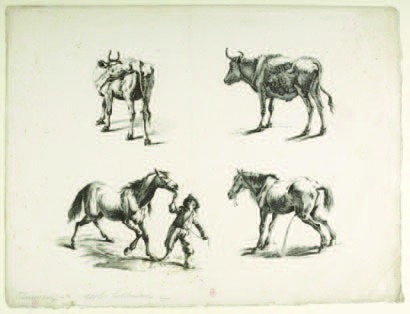
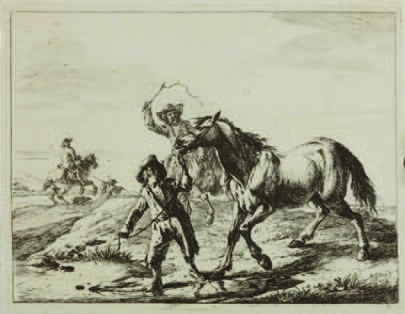
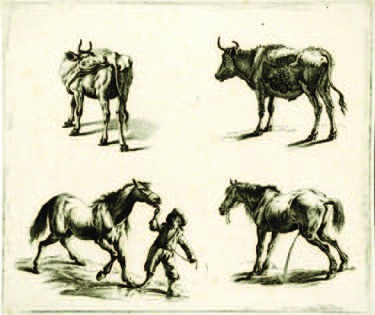
Source print. Etching by Ignace Joseph de Claussin after Dirk van der Stoop, identified by Isabelle Evrard (BnF) in the research carried out under Maxime Préaud and Michel Frizot. The horse-and-leader group, cut from Claussin’s sheet of four animals, matches the heliograph exactly in size.
On 7 August 1825 Niépce wrote to his brother Claude: “Je grave sur cuivre dans ce moment un cheval avec son conducteur, et un point de vue pris de la chambre où je travaille.” (I am at this moment etching on copper a horse with its leader, and a view taken from the room where I work.) The view has vanished; the horse remains. He had just found how to make a plate printable, painting and etching in turn “jusqu’à ce que j’aie obtenu le creux suffisant pour l’encre d’impression” (until I have obtained a depth sufficient for the printing ink).
On 25 October he tells Curley that he will have “deux ou trois copies de gravures” (two or three copies of engravings) printed. The proofs came back from Dijon before the end of the year, and on 14 January 1826 he admits that they “n’ont point la netteté et la correction désirées” (do not have the sharpness and accuracy he wanted). The Horse and the Jeune Fille à la quenouille (NN2) were printed together, in the same batch: NN1 comes first in this catalogue because its plate is the first Niépce names, not because its print preceded the others.
The two subjects did not travel alike. The Jeune Fille went to Paris in January 1826 in the colonel’s luggage, and was shown to the opticians. The Horse left two months later, sent by Isidore rather than by his father, slipped into an envelope for Curley between a price list of pumps and some papers on wine presses: “Vous trouverez, mon Cher Cousin, avec le Tarif des Pompes, un essai des gravures de mon père. L’épreuve est faible en couleur: cela vient de ce que le Cuivre n’était point assez attaqué; mais, c’est un défaut facile à corriger, et qui ne regarde nullement le procédé de mon père.” (You will find, my dear cousin, with the price list of pumps, a trial of my father’s engravings. The proof is weak in color: this is because the copper was not bitten enough; but it is a defect easily corrected, and one that in no way concerns my father’s process.) The papers are to be returned, the postscript adds, “excepté la gravure” (except the engraving). The cousin kept it; the BnF has it now, with the letter.
NN2 · Jeune Fille à la quenouille
The Spinner
Autumn* 1825 (copper plate, lost) · November-December 1825 (print on paper)
[m1] Copper plate, about 144×119 mm (from the plate mark; Marignier 1999), the image formed by light in a ground of bitumen of Judea, then etched with acid, autumn 1825. Lost, together with the source print.
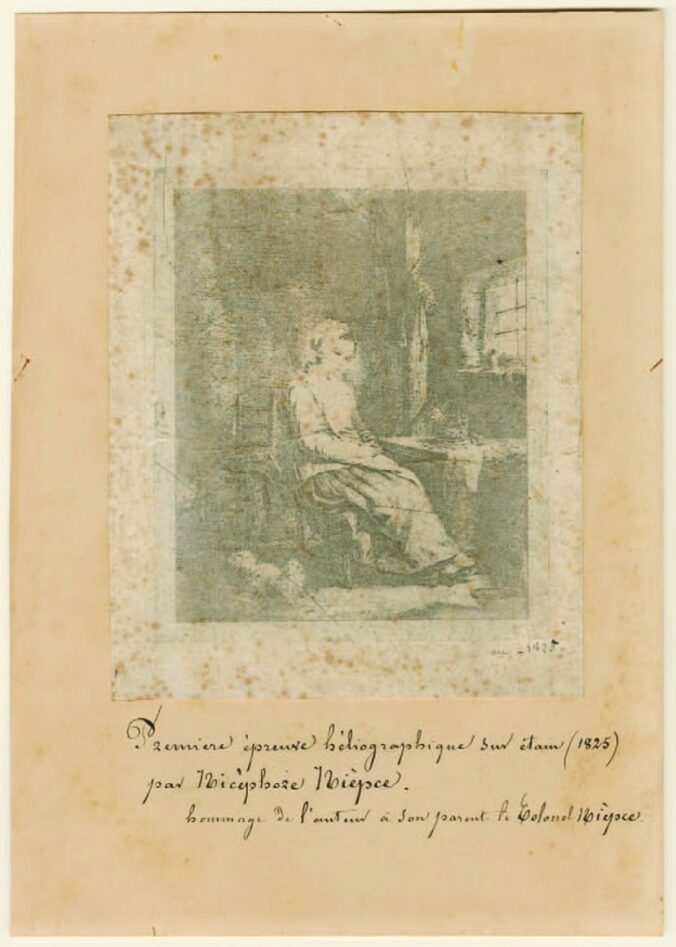
p1 · Print on paper, image 132×107 mm, sheet 178×144 mm, mount 223×195 mm. Dijon, certainly by Berthaux-Durand, November-December 1825. Inscribed in ink on mount in the hand of Isidore Niépce: “Première épreuve héliographique sur étain (1825) par Nicéphore Niépce / hommage de l’auteur à son parent le Colonel Niépce” (First heliographic proof on tin (1825) by Nicéphore Niépce, with the author’s compliments to his relative Colonel Niépce); in pencil in the margin: “1825”. In a gilt frame; on the back, in pencil, “A. Perrault-Niepce à Sennecey-le-Grand”, and a “Perrault-Niepce” label, both of 1933. Collection Michael S. Sachs.
Provenance. Given by Nicéphore Niépce to Colonel David Niépce, before 8 January 1826; probably lent to Isidore Niépce in 1839 in support of the priority claim, when the inscription was added; returned to the colonel’s family, and by descent to his great-granddaughter Léontine Niépce and her descendants, the Perrault-Niépce family, Sennecey-le-Grand; Sotheby’s, London, Photographs, sale L06430, 16 May 2006, lot 110; Michael S. Sachs.
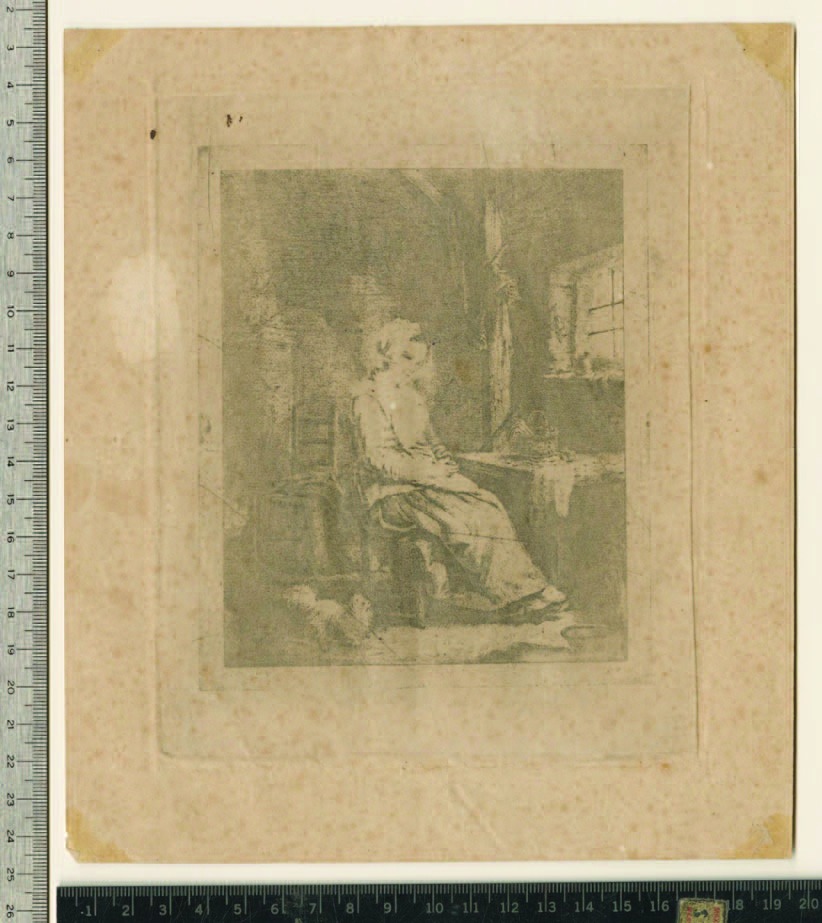
p2 · Print on paper, from the same plate, image 132×107 mm, sheet 178×156 mm. Without inscription. Collection Michael S. Sachs.
Provenance. Given by Nicéphore Niépce to Colonel David Niépce; by descent to the Perrault-Niépce family, Sennecey-le-Grand; Librairie Serge Plantureux, 12 May 2006; Michael S. Sachs.
Note. Michael S. Sachs acquired the two prints within five days: p2 privately, through the author, on Friday 12 May 2006 (invoiced on Monday 15 May), and p1 at Sotheby’s, London, on Tuesday 16 May 2006. The author presented p1 at Paris Photo 2026.
Source print. Not yet identified. The heliograph on paper must read in the same direction as its source print (see A Note on Method in the introduction). A previous lead: La Fileuse by Jean-Antoine Pinchon (1772-1850), shown at the Salon of 1824, and published as a lithograph “A Paris, chez Senefelder” (Paris, at Senefelder’s) (research by Isabelle Evrard, BnF), was closed by Nicolas Devigne, who found the painting described in a sale catalogue: an old woman at her spinning wheel, beside a little boy eating his soup.**
* The letter of 7 August 1825 names only the Horse and a view; the Jeune Fille first appears among the “deux ou trois copies de gravures” (two or three copies of engravings) announced on 25 October 1825.
** Galerie de Mme la duchesse de Berry au Palais Vendramin à Venise. Tableaux anciens et modernes, Drouot, 19 avril 1865, lot 345, “Une vieille femme est assise devant son rouet, tandis qu’un petit garçon mange sa soupe à coté d’elle” (An old woman sits at her spinning wheel, while a little boy eats his soup beside her), 50×60 cm.
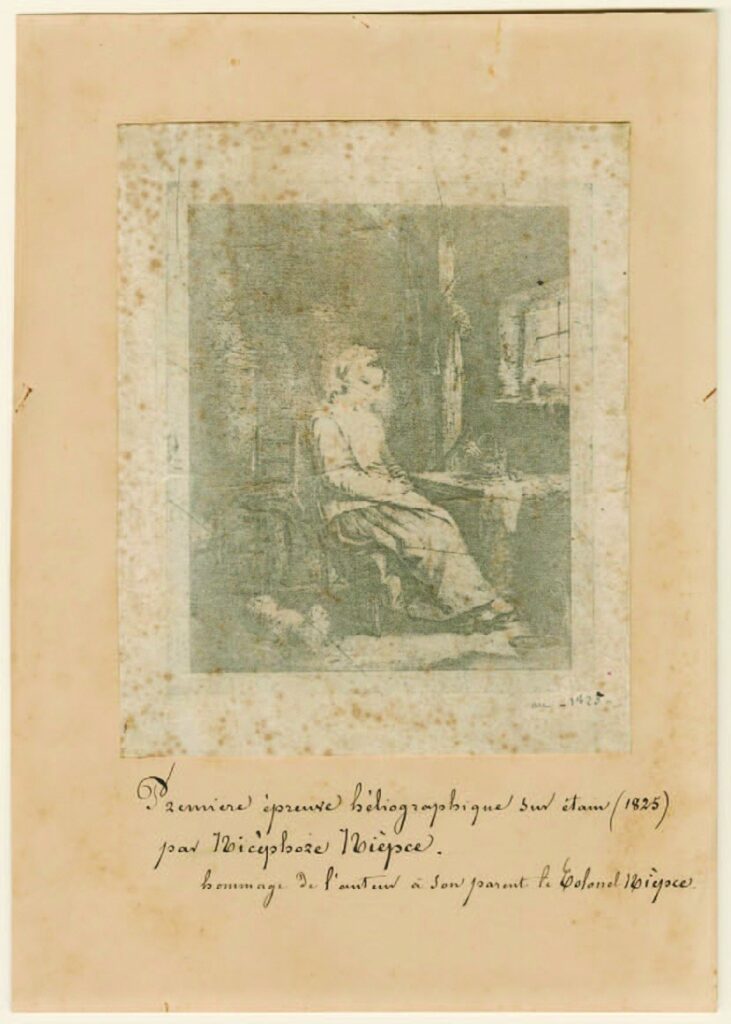
On 8 January 1826 Colonel David Niépce, newly appointed lieutenant du roi (king’s lieutenant) on the Île de Ré, left Burgundy with several heliographic prints his cousin had entrusted to him. On 12 January he called on the opticians Vincent and Charles Chevalier, quai de l’Horloge, Niépce’s suppliers since the summer, and among the prints he carried showed them one: “Jeune Fille filant sa quenouille” (young girl spinning at her distaff).
The story comes from the colonel himself, who told it “plusieurs fois” (several times) to Victor Fouque. Present in the shop that day, according to Charles Chevalier’s Souvenirs historiques, was the Comte de Mandelot, Henri Bataille (1753-1827). Daguerre, a client of the house, heard of it “le lendemain” (the next day), according to Isidore; within days he wrote to Chalon. A year later Niépce still wondered how he had been informed, “je ne sais trop comment” (I hardly know how), and Daguerre was still asking for a print. He had never seen one.
So this*** is the image with which the invention left Le Gras and met its first strangers: two opticians, an old count, and, at one remove, its future rival. Copper, not pewter. The mount says “sur étain” (on tin). The letters say copper. In 1825 Niépce was etching copper: he awaited his plates in June, etched the Horse in August, announced on 25 October that he would have “deux ou trois copies de gravures” printed, and on 14 January 1826 that the proofs of his “gravures sur cuivre” (engravings on copper) printed in Dijon lacked “la netteté et la correction désirées” (the sharpness and accuracy he wanted). Pewter arrives in the spring of 1826, ordered for the camera obscura; and as late as 22 January 1827 Lemaître had not yet etched it. A print shown in Paris in January 1826 came from a copper plate.
The inscription, written around 1839-1841, is right about the date and wrong about the metal. Its author has an excuse: Isidore had left his father’s house in 1822, for the army and then for marriage, and witnessed none of the experiments. His other labels share the habit: a small landscape at Chalon (NN4) dated “1825”, then altered to “1823”, a Cardinal printed by Lemaître in 1827 dated “1824”.
One plate, two prints. p1 and p2 share the same accidents of the plate: diagonals crossing the skirt and the floor, a mark near the face, a ring on the floor, the same registration on the edges. The two were pulled in Dijon, in the same batch as the Horse (NN1). Of the three, nothing tells which came first.
The printer. Around 1866, Victor Fouque was still asking Isidore about the Dijon printer his father had used: “Who is this friend of Carbillet?” The correspondence never names him. But it shows that the friend was a lithographer: in June 1824, a stone sent through Carbillet’s circle had already gone to “l’imprimeur-lithographe” (the lithographic printer), with instructions to print it “comme les planches de cuivre” (like copper plates). The history of lithography in Dijon is well documented.
*** (NN2-p1), with inscriptions
Peignot and Girault described its beginnings as early as 1818-1819; the Dictionnaire des imprimeurs-lithographes of the École nationale des chartes follows its practitioners: Mairet left Dijon in 1821, Berthaux-Durand around 1826-1827.
In November-December 1825, Dijon thus had only one lithographic printer in business: Berthaux-Durand, a land surveyor, who had set up his press with two workmen trained in Vienna. Niépce’s copper plates were therefore certainly printed at his premises. And the announcement of his departure from Dijon may well have encouraged Niépce to turn to a Parisian professional, Lemaître.
Laisser un commentaire